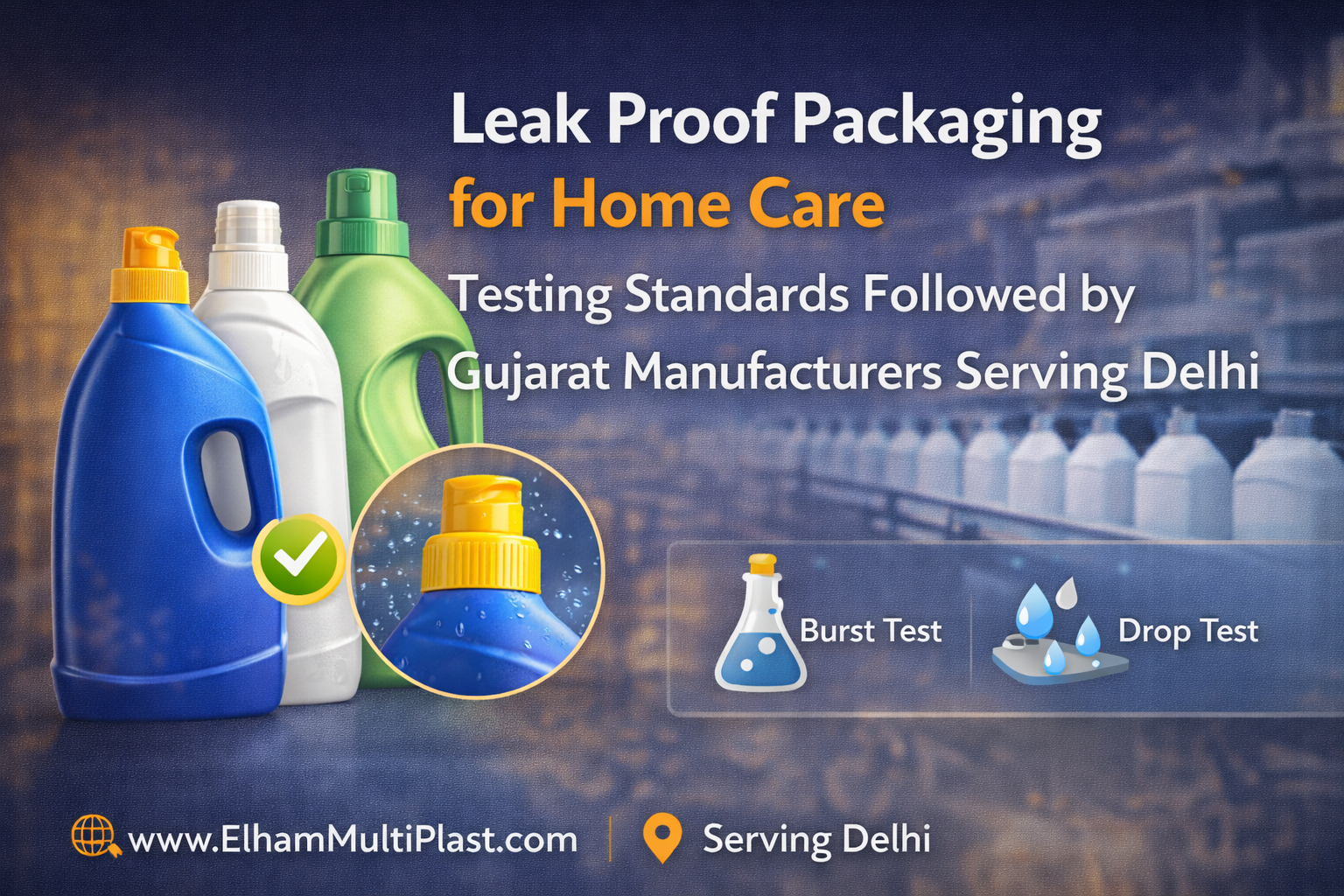
Leak proof packaging for home care — Testing Standards Followed by Gujarat Manufacturers Serving Delhi

More than just an inconvenience, leakage destroys shelf appeal, endangers the safety of consumers, attracts complaints, and leads to expensive returns at every level of distribution. When sourcing bottles for detergents, surface cleaners, phenyls and other household chemicals, procurement managers, quality heads and brand owners need to find packaging that withstands the rigors of manufacture, storage, last-mile transit, end-user handling, and then some.

The Elham MultiPlast LLP example demonstrates that manufacturers from Gujarat’s packaging cluster (which constitutes a significant portion of India’s packaging for the home-care segment) are able to assist Delhi’s FMCG market in the construction of modifiable HDPE and PET containers at an economically and productively balanced tier. The difference between a good supplier and a great one is the extensiveness and transparency of their leak-proof testing.

Most Important Tests Needed to Label Packaging as Leak-Proof.

Any supplier servicing the Delhi market would need to run and provide some documentation for the following testing categories—these are all within the Indian standards and the guidelines set for the manufacturers in Gujarat.

Visual and Dimensional Inspection

Each batch begins with simple checks for wall thickness, neck finish, mouth concentricity and closure fit. Aligning measurements helps avoid stress points that will later create leaks. While Indian Standards specify assessments and measurement checks for liquid polyethylene containers, checks should be conducted for all containers.

Closure Retention and Torque Testing

Even a perfect body of a bottle will still leak if a cap is not torqued correctly. Closure Torque tests determine the loosening and tightening torques (also called initial application torque and conditioning retention torque). Today’s torque testers are capable of producing repeatable and auditable tests that can be used as acceptance criteria for procurement contracts. Most tech labs use ASTM-style torque tests.

Mechanical (Pressure/Vacuum/Bubble) Leakage Tests

Pressurization and vacuum techniques, verified with a soap and water bubble test for small containers, are used for leak detection. These tests reveal micro-channels at seals, liner failures, or closures that are not fully seated. Closure leak and pressure-tightness tests are among the Indian test protocols for liquid containers that include compliance with the tests for plastic containers.

Mechanical Shock and Transit Simulation (Drop, Vibration, Compression)

A bottle may be sealed at the factory and still leak after transit.
ISTA regulations (like the ISTA 1A/3A family, which parcel shippers use) simulate the impacts of drops, shakes and compressions during parcel processing and retail handling. These simulations are vital for e-commerce and for the modern distribution of goods to Delhi. Suppliers, who qualify their prepackaged goods using ISTA methods, will experience fewer failures in the marketplace.

Chemical compatibility and soak testing

Home care liquids can be aggressive due to their high alkalinity, presence of solvents, and overall surfactant use. Soak testing, as well as compatibility testing, involve immersion (at room and raised temperatures) for specific time periods. Testing will confirm that there is no unsatisfactory swelling, crazing, color bleeding, or loss of performance from seals. With commodity HDPE, the fluorination or barrier treatments may be necessary for aggressive chemistries. These methods are covered under the Indian standards for specialized HDPE containers.

Accelerated ageing and environmental conditioning

Packaging designed for Indian Warehouses that is meant for use over multiple seasons must be able to withstand and function optimally during Hot and humid weather, periods of intense cold, and thermal shocks. The method of accelerated ageing, which includes exposure to elevated temperatures and cycles of high humidity, is used to assess and evaluate the long-term integrity of seals and the potential for cap torque drift. How manufacturers in Gujarat operationalize these tests Gujarat’s manufacturers usually take the above-mentioned testing categories and turn them into an operational QA matrix for procurement teams. This matrix should be requested and reviewed before final approval.

Sampling and acceptance standards

The BIS/Indian standards outline the rules concerning the sampling of lots, types of tests (destructive and non-destructive), and the acceptance of defects. A good supplier will provide the sampling plan (for instance, 2% of the lot as per IS sampling tables) and the test results for every lot they ship.

Quality control Checkpoints

Good plants provide inline visual/torque check and run destructive tests (burst, tensile of closures, seam peel) on a schedule, if offline is done. Elham MultiPlast LLP and other mature suppliers from Gujarat combine inline monitoring with timely scheduled lab tests so that the earliest drifts prompt early corrective measures before complete lots are released.

Certification of third parties and laboratories

Brands dealing with higher risk home care chemistries, request third party lab reports for the leaks and chemical compatibility. A lot of buyers from Delhi request ISTA lab reports for transit simulation, and torque and leak certifications from NABL accredited labs. A report from a reputable lab, accompanying the shipment, minimizes the disputes during receipt.

More buyer practical acceptance criteria

Procurement teams should consider tests with the go/no-go approach. A couple of practical suggestions:

1. Closure torque: Average retention and standard deviation with retention within X% after conditioning. Define X in the PO. Use calibrated standard.

2. Leakage: No visible leakage at specified pressure/vacuum with the whole sample. Define parameters for the soap-bubble detection (size and time) for the sample.

3. Transit simulation: No structural failure or leakage per the agreed ISTA procedure (Specify the ISTA procedure in the contract).

4. Chemical soak: No visible degradation, mass change or cap-seal failure after the agreed soak (time/temp/chemical concentration documented).

Integrate these in the technical specification (TS) and incoming QC at your Delhi warehouse

Real-world examples and lessons learned

1. Missing torque Control Leads to Consumer Returns. A mid-sized FMCG brand tracked a 2% return rate due to closures being too loose. Result of the manual capping was without torque control. Supplier invested in an automatic torque-applicator and torquing certificates, return rate dropped to near zero.

2. E-commerce transit shows weak seals. A brand’s online marketplace sold product(s) that garnered complaint(s) due to customer receiving product(s) with cap stain(s). Leakage complaint(s) ISTA 3A testing identified a design flaw in closure liner compression drop(s). A simple geometry modification to the neck finish resolved the problem. ISTA pre-qualification certifications eliminated the potential of future SKU failures.

3. Chemically induced material improvements. A detergent with a solvent booster was determined to have an acceptable shelf life only with fluorinated HDPE or a liner. Field discoloration and overall packaging failure was avoided by the buyer and the manufacturer collaboration (materials trial + soak testing). Fluorination and like treatments are considered and are in the standards of the BIS materials guidance.

These are simple examples of why a strong and comprehensive a comment QA process, clearly stated TS documents, and testing transparency overshadow the lowest piece per unit price.

Procurement checklist for Delhi buyers (quick version)

1. Ask for QC matrix and sampling plan (BIS alignment if applicable).

2. Torque reports and calibrated instrument details.

3. Reports per specified ISTA protocol for e-commerce or interstate distribution.

4. Chemical compatibility and soak test (concentration, temp, time) data.

5. Certificates from third parties for critical SKUs (preferably NABL labs)

6. Unambiguous remediation and recall clauses linked to documented shortcomings.

Working with Gujarat suppliers like Elham MultiPlast LLP

When you source from Gujarat, select partners who will collaborate on spec development, pre-qualification runs, and joint testing. Elham MultiPlast LLP — as a Gujarat supplier — exemplifies a partnership model: prototype runs, collaborative ISTA sample runs, and real-time torque/leak test reporting on each approved lot. That level of transparency and capacity is what Delhi procurement teams need most.
When you onboard, conduct a pilot batch, and request lab reports. From supplier promises to quantifiable accountability, these steps are a primary tool.

Final note: standards, documentation, and risk mitigation

Indian and international standards collectively provide the basis for a defendable leak-proof packaging standard. BIS provides the standards, GUIDES the sampling and testing, and ISTA and industry torque/test methods provide the testing and industry simulation. Use all of them together and demand documented testing to minimize the chances of failure once the product is delivered to the market.

Quality assurance is a collaborative effort, and all aspects of the design, the materials, the tooling, the capping, and the distribution the packaging. For Delhi’s demanding home-care market, the outcomes are best with suppliers who thoroughly test and share their findings. Manufacturers from Gujarat, like Elham MultiPlast LLP that observe these principles, help brands minimize product returns, provide for the safety of the consumers, and sustain profit margins.
Selecting an HDPE bottle supplier in Hyderabad’s Personal Care Market

Choosing the right packaging partner for Hyderabad’s personal care brands is a key strategic choice. Whether in shampoo and conditioner, lotion and cream, or hand sanitizer, packaging serves a multifaceted purpose, impacting product stability, brand perception, regulatory compliance, and the cost of goods sold. This guide, developed for Elham MultiPlast LLP, walks procurement managers, brand owners, and manufacturers through an expert selection process for packaging suppliers and describes how to identify an HDPE bottle supplier in Hyderabad can depend on.

Why HDPE is a leading choice for personal care packaging

A leading choice for personal care packaging, high-density polyethylene (HDPE) is used due to its chemical resistance, toughness, and ability to mold into different shapes. Most formulations (aqueous gels, surfactant-based shampoos, and most oils and lotions) of HDPE containers offer a balance of quality and cost. However, HDPE’s compatibility with an active ingredient, fragrance, and or solvent is dependent and thus the need for compatibility testing beforehand is essential. Some industry guides state that a containers design, wall thickness, and exposure duration to temperature can all impact the instances of permeation and compatibility.

Start with a supplier checklist (what matters most)

In using packaging suppliers in Hyderabad, creating a checklist for each supplier is the best start to evaluating personal care packaging Hyderabad suppliers, which should include the following:

1. Regulatory expertise: supplier possesses knowledge of India’s cosmetic industry regulations as well as the applicable labeling requirements.

2. Customization & tooling: ability for color, neck finish, embossing, co-extrusion, or post-molding (closures, pumps) operations.

3. Quality systems: ISO / in-house QC, sample approval, and pre-shipment inspection.

4. Lead times & logistics: reasonable MOQs, active production lead times, and freight options to Hyderabad.

5. Sustainability: alternatives for PCR materials, recyclability claims, and certified inks. Using a checklist in conjunction with a sourcing guide can mitigate the chances for errors for both manufacturing and launching products. Larger order production pilots and independent inspections are recommended.

Labeling and Regulation for Hyderabad Brands

Cosmetic products in India must legally follow the Cosmetics Rules 2020 and the respective guidance from CDSCO. Packaging is part of the compliance and must have the declared size of the package, list of ingredients, the name and address of the manufacturer, and regulatory claims on either the primary or secondary packaging according to the rules. Suppliers must have some knowledge of the regulations and should be able to assist with the regulatory compliant labels and labelable surfaces. It is crucial to engage with suppliers who have supplied the cosmetics or personal care industry, and can provide regulatory documents.

Supplier capabilities to verify in a Practical Sense

In regard to potential suppliers of HDPE plastic bottle manufacturers Hyderabad, here are some checkable capabilities:

1. Sample-to-pilot workflow: For the production of pre-sale, or low-cost pilots, set color (Pantone), and a short sample run for Fill-line testing.

2. Neck and closure tolerance: Provide the pump or closure samples and have the Supplier conduct a fit test. Rework due to a condition where the bottle misaligns or does not close properly can be expensive.

3. Surface finish for labeling: Various HDPE grades have different surfaces; some have a matte finish while others accept shrink sleeves or direct print labels more easily. Verify adhesion tests for your selected label or sleeve method.

4. Batch traceability: The supplier must trace production batches, and in QC, document retention — this protects you in case a recall or a complaint you may receive.

5. Sustainability options: For recycled content, ask for documentation (PCR certificates) along with confirming that the supplier can handle color variability.

These checks indicate typical failures we see in launches: closures not matching, labels peeling off, or unexpected fading under UV/light exposure.

Commercial Terms: MOQ, Pricing, and Total Cost of Ownership

The price per bottle is one of many elements to consider. For the custom HDPE bottle suppliers from Gujarat to Hyderabad, complete total cost of ownership models for the following:

1. Unit price × MOQ × number of SKUs

2. Forgone revenue / write-off that can be attributed to one-off custom molds (Tooling amortization)

3. Scrap (custom molds) / yield (how many go to the rest of the pieces)

4. Hyderabad (road or rail) and insurance and freight

5. Safety stock and the cost associated as lead times increase

When negotiating, flexible MOQs for pilot SKUs along with staggered deliveries and shared tooling for similar SKUs can significantly impact the initial cash outlays associated with private labeling.

Quality assurance and testing to demand

For each supplier, request and examine incoming material certifications, along with tensile and impact testing (if relevant). Also, ask for compatibility testing against your formula. If your product has any of the following: solvents, high ethanol (e.g. hand sanitizers), or essential oils, ask for a formal compatibility study. If needed, use independent testing labs. Pre shipment inspection documentation and acceptance protocols upon receipt in Hyderabad will be helpful in minimizing disputes and product returns.

Sustainability and acceptance of Indian standards

To end consumers and retailers alike, your sustained practices will positively affect community perception. The standards and guidelines of the Bureau of the Indian Government are increasingly pointing to any mention of recyclability; standards are providing guidelines for labeling recycled content, and for the segregation of waste. Talk to your suppliers about the availability of PCR (post-consumer recycled) content, clear recyclability coded bottles, and stream compatible, unprinted, non-label adhesive bottles. Sustainable packaging with documented processes meets your procurement policies and the retail listing requirements.

Onboarding a Supplier: Recommended Steps

1. RFI/RFQ with sample request and checklist provided.

2. Following lab testing, material and closure compatibility must be confirmed.

3. Pilot run (1–2 pallets) and online fill trials in Hyderabad.

4. Quality acceptance checklist sign-off and contract with SLAs (lead time, rejection, rework).

4. Quarterly evaluations that include captures the rate of defects, delivery delays, and cost variances.

This phased method helps to protect the company’s brand equity and cash flow, while also making it possible to increase operational capacity.

Selecting the right partner: what distinguishes vendors

The vendors that excel in Hyderabad’s personal care market are distinguished by the integration of technical knowledge and service:

1. They share technical reports and data on compatibility in advance.
2. They conduct fit tests with your actual closures and pumps.
3. They provide the ability to increase operational capacity and are flexible in their ability to sustain quality control during small scale pilots.
4. They provide regulatory assistance or documentation that supports the labels and material tests.

If you want a partner to provide a balance of competitive pricing with a high value in customization and regulatory compliance, seek out manufacturers who supply national personal care brands and private-label clients.

FAQs

1. How can I find out if my shampoo or conditioner will work with HDPE?
Talk with the supplier regarding their chemical-compatibility data and conduct an accelerated stability test (in a sealed bottle, expose the bottle to heat and light) with your formula and closure. test it for 30 to 90 days. If your formula contains a solvent or a high alcohol content, ask for formal compatibility testing.

2. Is it possible to rely on Gujarat suppliers for deliveries to Hyderabad?
Yes. Most Gujarat suppliers ship to all parts of India. Get information regarding the lead time, freight partners, and insurance on the delivery. For your first order, conduct a test on the shipment, and make sure it contains a buffer stock to account for the delivery time inconsistencies.

3. How high of a minimum order quantity (MOQ) can I expect?
There cannot be a single MOQ due to the number of variables that influence the answer: stock bottles can be obtained with an MOQ of a few hundreds to a few thousands; custom molds usually entail a minimum order quantity that is much higher to be able to offset the costs of the tooling. Where possible, try to obtain an agreement for staggered runs or a shared tool.

4. Are recycled HDPE options available for personal care?
Yes—suppliers are increasingly providing bottles with recycled content. There may be some variability with color and batch consistency. Ensure that you have certification for recycled content (PCR) and conduct adhesion and compatibility tests for labels and closures.

5. What documentation should the supplier provide to support regulatory compliance?
You should obtain materials certificates, reports concerning migration and extractables (if relevant), batch traceability documentation, and any tests related to the cosmetics labeling requirements, along with an assurance that the bottle complies with the pack size and labeling requirements of the Indian Cosmetics Rules.

Choosing the right private label bottle supplier Hyderabad (or an established HDPE bottle supplier India Hyderabad) requires a combination of technical validation, commercial justification, and operational fit. Using the checklist and roadmap, demand samples and conduct necessary tests, and engage with suppliers who have the right balance of production experience, regulatory insight, and quality assurance transparency—so your product launches in Hyderabad are visually appealing, function as intended, and comply with regulations. If you prefer, Elham MultiPlast LLP can assist with sample bottles, guidelines for compatibility testing, and a pilot run designed to meet the requirements for personal care products in Hyderabad.

Sourcing an HDPE detergent bottle supplier for Mumbai FMCG lines

The right bottle supplier is also a very high-leverage procurement decision for liquid detergent brands, private-label homecare manufacturers and contract packers that may be running high-volume lines in Mumbai. We’ve literally been by thousands of meters of production line, beside filling lines in halls and designed moulds to support new SKUs as well being there to resolve the actual problems buyers have on their plate – down time from poor bottles that are too heavy which can lead to inconsistent wall thickness; a greater degree of variation so there is no consistency from batch delaying the project or causing havoc with cap fitment difficulties as well creating logistics errors. This article distils that experience into a practical, step-by-step playbook to choose a partner who will produce the quality, consistency and service they promise.

What makes HDPE the most popular detergent bottles and home care packages?

HDPE brings together chemical resistance, impact strength and cost effectiveness: attributes that a liquid detergent or floor cleaner are looking for. HDPE tends to be the best material for packers who require leak-proof performance at high running speeds and reliable feeding of moulded parts. (Refer to applicable Indian packaging and material standards for food/contact safety and requirements on materials).

What procurement teams should be judging first (and how we evaluate it)

When we are vetting a potential HDPE detergent bottle supplier Mumbai candidate, this is the checklist we go with and you can verify/inspect each and every item from our list during an on-site visit or as part of a sampling round.

1) Process capability & Mould quality
Ask the supplier to show you their tool room and sample molds. Supplier who is in charge of mould maintenance and can rapidly change cavities, will result on low cycle time and rejects. At Elham MultiPlast LLP, we evaluate the first-shot reject rate and batch-to-batch dimensional variation before approving any new mould.

2) Material traceability and grade
Confirm resin grade (HDPE grade, virgin vs. PCR content) and request COAs. For formulations that touch consumer skin or market as “safe”, our packaging decision is also influenced by BIS/FSSAI guidance and food-contact standards — so documentation counts.

3) Wall-thickness control & dimensional repeatability
On high-speed filling lines, a 1% variation in weight or neck finish can cause jams or leaks. We sample 30–100 bottles and test pour, neck concentricity, and cap torque to check repeatability under real operating conditions.

4) Secondary operations & finishing
Look for suppliers offering fluorination or plasma treatment (if required for chemical compatibility and barrier improvement), reliable labeling surfaces, and compatible closures. For certain chemistries (pesticides or aggressive solvents) there are specific ASTM / IS test regimes, ask for a test report.

5) Quality systems and sample history
Check CAPA records, inspection reports, and the historic PPAP-style dossiers of past customers. A supplier documenting incoming resin batches, machine SOPs, and rejection causes will save you countless headaches on-scale up.

Practical procurement playbook for Mumbai FMCG lines

Step 1: Define the SKU with manufacturing in mind
Design the bottle for the line (neck finish, closure type, fill volume tolerance). Skip the consumer image for now — start with line speed and filling type to refine how it fills before you tweak the aesthetics. We recommend prototyping 3 variants: a conservative HW, a prod-friendly MW, and a cons-appeal LW — then run each in a fill trial.

Step 2: Once your project reached this step, then just ask for…
You should never be satisfied with a single sample image. You’d go to the supplier warehouse and ask for a sealed pack (date-coded) then you’d run 2,000 – 10,000 pieces as a pilot to shake out hidden problems: improper stacking, shrinkage in hot warehouses, drift in cap torques.

Step 3: Check logistics & lead times (Mumbai)
Mumbai, India Logistically central to a lot of Western & Central Indian operations, port congestion and about holidays can affect lead times as does the monsoon. We create a short list of suppliers with an easily verifiable documented track record of on-time delivery and/or who have regional warehousing to smooth out the weekly non-linear lead time. Local directories list many small suppliers in Mumbai — but you should focus on those that offer both scale in manufacturing operations and systemized logistics expertise.

Step 4: Price vs total cost of ownership (TCO)
Hidden costs often lurk behind a low unit price: Rejected measurement, quality control (QC), get back time in production and rework. The cost of goods over 3 months, factoring the projected rejects and storage. At Elham MultiPlast LLP we provide TCO infographics, in which a customer can compare apples-to-apples between multiple quotes.

Technical considerations unique to detergent & floor cleaner bottles:

Chemical compatibility & barrier needs
Certain concentrated detergents and solvent-based floor cleaners may be aggressive and should be avoided so as to not migrate or soften low-quality, high-density polyethylene. We suggest (for those formulations) desirable HDPE grades and – when necessary, surface-treatment or internal barrier layers. IS, as well as national guidance is available for some of these categories — ask your supplier for material certificates and test data in this case.

Ergonomics and pour control
For consumer preference — and to avoid returns — consider handle placement, spout geometry and pour rate. We test it in acceptance testing by simulating actual commercial use pouring and calculating drip rates as well as cap reseal performance.

Recyclability and sustainability targets
Mumbai brands are more and more having to make commitments towards sustainability. Verify that the supplier can provide PCR content options, take-back programs or at least nth generation bottles for mono-material recycling. Bureau of Indian Standards compliance and BIS advice on sustainable packaging comes in handy here.

Why a partner in Mumbai is critical (logistics, regulation, speed…)

Choose a bulk detergent bottles supplier Mumbai to reduce inland transit time, freight economy and communication convenience for on-demand supply. There are many small and mid-sized mould makers and cap suppliers within the manufacturing hub of Mumbai helping to reduce lead time for urgent tooling fixes as well. That being said, market directories list a wide variety of supplier types — from small one-machine shops to large-scale manufacturers — so be sure you perform due diligence.

How Elham MultiPlast LLP deals with suppliers’ commitments (A brief case study)

When an upstart regional detergent brand from Pune approached us for a launch with 2 SKUs and demand of 50,000 bottles/month to be launched on spec date with shoestring budget. We proposed:

1. A purpose-built production slot for TOC on our extrusion blow machines to ensure supply.
2. Validating the compatibility of Filling Line: Pilot run with 3 different neck finishes.
3. A common KPI dashboard (on-time delivery, rejects, resin batch IDs), so procurement could follow the performance on a day-to-day base.

The result: no line stoppages in the first month of launch and a reduction in rejects by 30% compared to their previous supplier. It is this documented, measurable and repeatable approach that we tell customers when they inquire for a dependable Liquid detergent bottle supplier Mumbai.

Quick Checklist to give your suppliers (cut and paste)

1. Resin quality and COA for each production batch (virgin/PCR %)
2. 30-unit sample for Dimensional & Torque testing
3. Proof of surface treatment or fluorination (if necessary) and related test certificates. (Law Resource)
4. Last 6 months On-time delivery performance
5. Traceability: batch numbers and packing list of each shipment

Final recommendations

1. Focus on consistent quality and documented procedures rather than the lowest bid.
2. Run a full pilot on your real line — nothing beats validation in the real world.
3. Prefer a supplier who will co-manage on continuous improvement (tool maintenance vs. packaging optimisation & TCO reductions) 27.
4. Elham MultiPlast LLP can, upon request, present a pilot plan and a sample QC protocol according to the filling line you own and detergent formulation you have.

FAQs

Q1: How can I check the HDPE resin of a supplier is safe for my detergent formula?
Get a COA from the resin supplier, check that the grade of polymer is correct and ask for migration/compatibility testing to your actives. For food or skin contact claims, ensure competitive check basis FSSAI/BIS guidance.

Q2: Is fluorination a must for detergent bottles?
Not always. If for aggressive formulations, fluorination or plasma provides barrier and chemical resistance, you can ask for lab data to show the added benefit to your SKU. (Law Resource)

Q3: How about the MOQ?
Minimum order quantities depending on the supplier and bottle complexity. Big factories, low unit costs at larger volume orders but small shops with high MOQs to cover tooling setup. We’d recommend planning a buffer of 2–3 months for any new SKUs.

Q4: How can I minimise reject rates after changing suppliers?
Conduct a trial with the supplier together, consolidate on acceptance criteria and asking suppliers to provide batch IDs and inspection information on resin. Install a close loop in the problematics and demand actions plan when it’s need.

Q5: Can I acquire bottles in Mumbai for national distribution?
Yes — its logistics infrastructure in Mumbai should enable easy distribution all over India, but you may want to check the supplier’s warehousing and freight partners so that there are no local capacity bottlenecks. Begin by using local supplier directories and verified manufacturers.

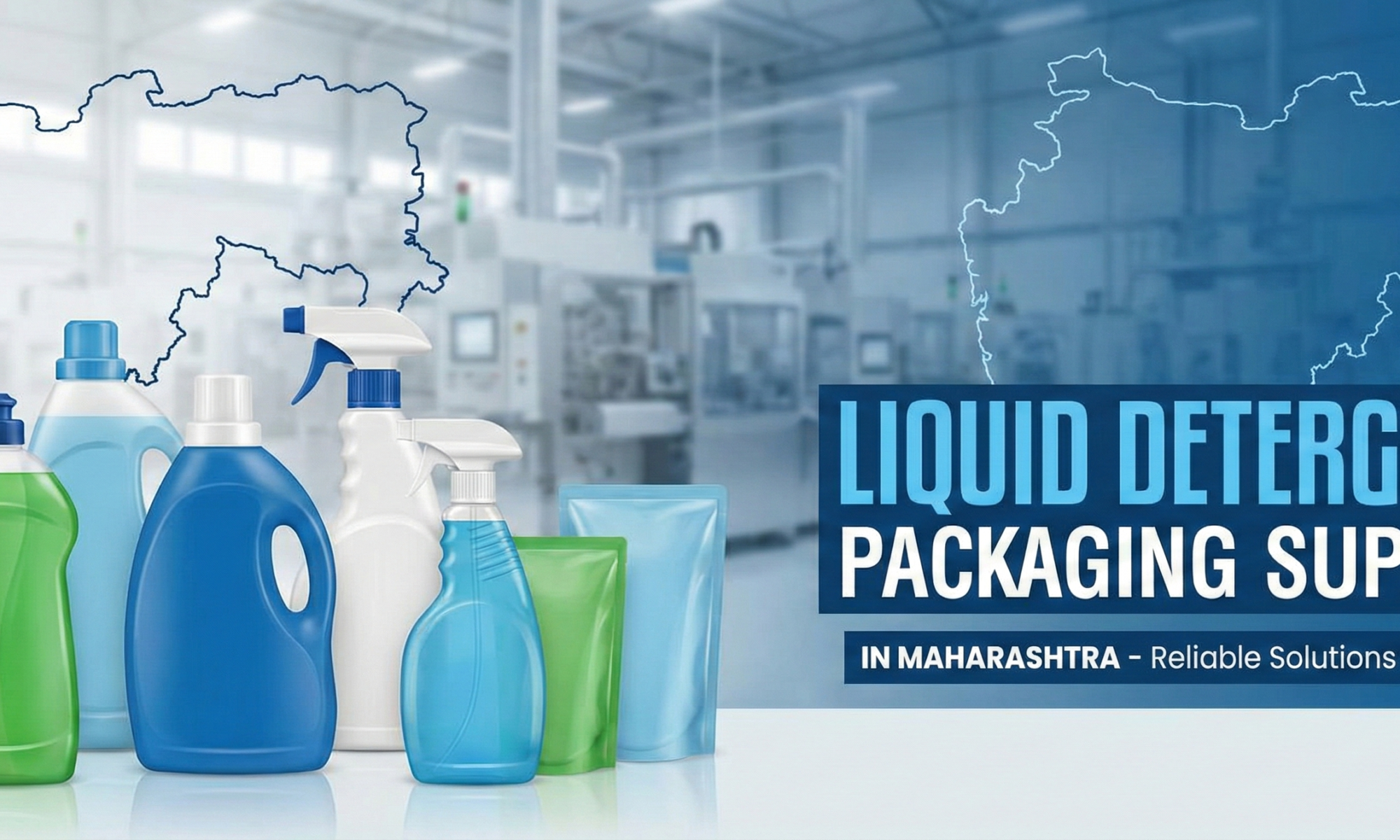
Liquid Detergent & Home Care Packaging Supplier in Maharashtra

The home-care packaging market of Maharashtra has progressed significantly in the last ten years. Small FMCGs and regional manufacturers need sturdy, regulatory complaint and affordable packaging solutions for liquid detergents, phenyls, fabric whiteners, surface cleaners and allied chemistries. This article is written to give you a sense of what to expect from a Liquid detergent bottle supplier Maharashtra works and evaluates the relationship with the right manufacturer – complete with real examples based on experience, and practical criteria that can be applied when evaluating potential suppliers.

Competitive landscape and buyer expectations

Maharashtra is one of the biggest consumer hubs for home cleaning products in India. When sourcing packaging, purchasing teams typically focus on these four characteristics: chemical compatibility, leak-proof closures, wall-thickness uniformity and fill accuracy and availability at volume. A reliable home care packaging manufacturer Maharashtra will provide documented quality systems, lab compatibility data and transparent logistics programs covering the inland distribution to Mumbai, Pune, Nashik including rest of the markets.

However, real-world buying behavior reveals a pretty clear line in the sand: National brands want certified, higher-spec HDPE and PET solutions while regional and private-label buyers are more likely to weigh cost against performance. This split has resulted in a diverse supplier base with some focusing on premium, compliance-heavy production and others doing high-volume, cost-optimised runs.

Materials, construction and performance considerations

Picking the right resin and bottle are essential, she adds.

Resin and barrier properties

HDPE is the material of choice for most liquid detergent bottles due to its chemical resistance and stiffness. Aggressive formulations and/or applications where transparency is required, PET can be used. Find vendors that offer material certification (resin batch testing reports, for example) and stress-crack resistance information. Trusted HDPE bottle manufacturer India should be capable of providing accelerated compatibility results with alkali, surfactant and solvent based products.

Construction and closures

Details like ergonomics of the handle, how the neck finish feels in your hand, shoulder geometry, thickness of base — these are all factors that directly relate to fill line placement accuracy, user end experience and shipping’s “durability”. Simple industry improvement: switching from a generic cylinder bottle to molded ergonomic bottle with knurling resulted in 8% more bottles per pallet and less damage in transit for regional detergent brand. Demand drop-test data and closure torque specifications from suppliers.

Systems quality, compliance and testing

Regulatory compliance and quality assurance is not up for debate. Trusted suppliers maintain:

1. Incoming resin inspection and traceability.
2. Compatibility testing for the specific chemical formula may be performed in the same laboratory or a third-party facility.
3. Dimensional inspection (go/no-go gauges) and weight-control SPC.
4. We perform batching labelling and barcode the batches for traceability.

Ask for quality manual excerpts, customer audit evidence, and corrective action logs from one of the Plastic packaging solutions Maharashtra suppliers. These papers show an implementation commitment to reproducibility at scale.

Customization, tooling and lead times

Tooling choices distinguish suppliers. Single-cavity tools are cheaper but have geometry limitations and lower throughput; multi-cavity units raise capital investment but lowers per-unit cost and offers better shape uniformity.
Illustration: A private-label client needed a customized 750ml dispenser that included a pour lip. Teaming with a supplier that provided in-house mold design capability and rapid prototyping (3D-printed try-outs followed by aluminium pilot tooling) enabled LANXESS to shrink time-to-market by six weeks compared to outsourced mold design. This highlights the benefit of partner suppliers such as Bulk detergent bottles suppliers that offer end-to-end design and manufacturing.

Be realistic about lead times. It takes weeks to produce and validate new tooling, while matching colours and second printing/labelling consume more days. The better supplier will give you a Gantt-style production timeline that includes resin purchase, molding times by cycle, quality inspection intervals and shipment dates.

Sustainability and circularity

It’s gotten to the point that sustainability is becoming less of a marketing adds on and more of an operational necessity. Suppliers are offering solutions that include recycled content (PCR-HDPE), mono-polymer designs to facilitate recycling, and lightweighting options that do not compromise rigidity versus volume of resin used.

A case in point: A local brand and their supplier replaced a 500ml thick-walled bottle with reengineered wall geometry, which led to a resin reduction of 12% (and allowed the application to pass drop and leak tests). For those buyers looking for green, ask the supplier about PCR percentage options and documentation on post-consumer recyclability.

Logistics, warehousing and distribution in Maharashtra

Proximity to the largest logistics centres accelerates response time and minimizes shipping cost. Suppliers with warehouses around Nhava Sheva, Mumbai and container yards (depots) can provide buyers with LTL consolidation shipments and fixed-time deliveries. When choosing a supplier of Household clean bottle, consider:

1. MOQs and pyramid batch sizes.
2. Zero-pull (kanban-style) programs for stable items.
3. Standard of palletization and INSURANCE AGAINST transit damage.

Sample shipping records, packing lists and a distinct path for damaged product are clear signs of operational readiness.

Price structure and total cost of ownership

Price per item is just part of the equation. Total cost includes:

1. Freight and storage.
2. Rework and rejection rates.
3. Line changeover time relating to neck finish and closure compatibility.
4. End-of-life costs and compliance risk.

A vendor able to deliver lean-packaging design and consistent tolerances is worth its weight in filler-line downtime reductions and rejects — frequently even if unit price may be slightly higher. A TCO exercise conducted by procurement comparing cost per unit to historical reject rates and line-speed limitations.

Supplier assessment and selection – a practitioner checklist for use in industry

1. Material qualification: Check for resin certifications and compatibility testing.
2. Quality and traceability: Ask for inspection reports, SPC data and batch traceability.
3. Tooling ability: Check in house mold making and prototype lead time.
4. Sustainable alternatives: PCR content, mono-material forms and lightweighting.
5. Supply continuity: Where your warehouses are, lead times, _how you reorder and what to do if things go wrong.
6. Technical support: R&D, sample development and trouble-shooting during scaling up.
7. References/case studies: Request client reference cases or anonymized examples of scale-up and resolution of issues.

A provider that checks these boxes over and over is a good fit for Google’s E-E-A-T standards of expertise and trust.

Why we do it with long established partner like Elham MultiPlast LLP

Businesses who possess a manufacturing depth, yet are also dependable on the supply chain will always have an edge in quality and service. Elham MultiPlast LLP is a supplier that establishes itself to cater for custom as well as stock needs for liquid detergents and home-care chemistry: HDPE and PET, multi fill volumes though options of secondary finishing and private label supply.
When a supplier like Elham MultiPlast LLP offers documented compatibility testing, pilot-run support, and logistics coordination for Maharashtra markets brands are able to realize predictable fills, lower line down time and faster route-to-shelf.

Ultimate considerations for buyers

1. Kick off procurement with a brief technical spec sheet: state the chemical composition, fill temperature, target shelf life and needed certifications.
2. Call for trial fills and brief validation run before placing full-scale orders.
3. Rate suppliers on operational criteria (such as reject rate, delivery times and responsiveness) over a 90-day review period.
4. Look into long-term relationships, such as those with co-development for sustainability and cost reduction.

A strategic packaging provider is an extension of your manufacturing ability. Selecting the perfect Liquid detergent bottle supplier Maharashtra It’s all about striking a balance between cost, process maturity, technical competence and logistics reach. Suppliers with robust quality documentation, development support and supply continuity will lower risk and increase margin in the long-term.

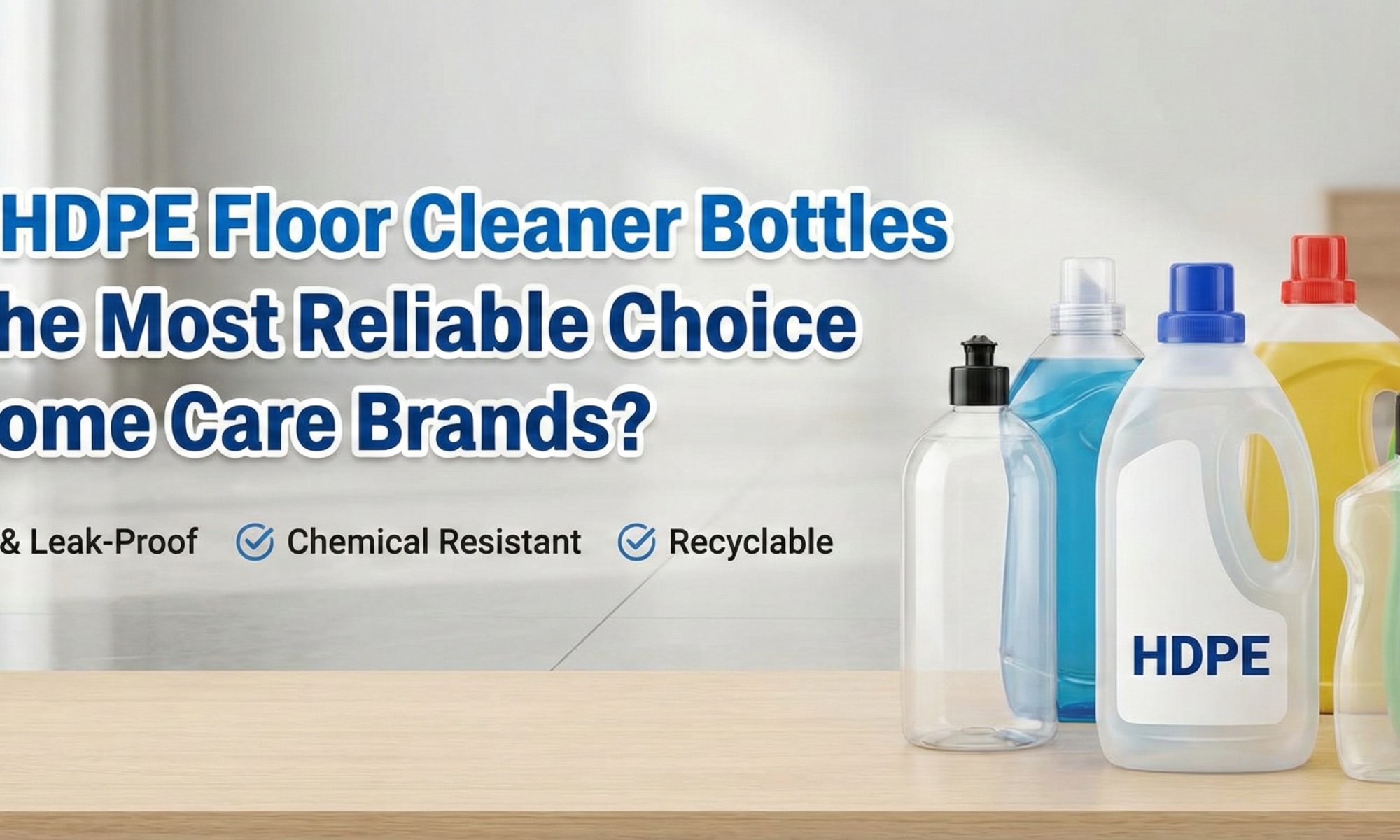
Why HDPE Floor Cleaner Bottles Are the Most Reliable Choice for Home Care Brands?

Introduction

The proper selection of packaging for floor cleaners should not only be considered an aesthetic choice, but more of a technical, regulatory, and brand protection choice. Home care brands must consider elements such as chemical compatibility, durability, safety, and cost, and HDPE floor cleaner bottles are the only option that perfectly satisfies all of these factors. My professional background as a manufacturer and as an employee of quality control such as from Elham MultiPlast LLP helps me elaborate on the material science, the control of manufacturing processes, the benefits of design, and the advantages of using HDPE floor cleaner bottles that are the most reputable for home care lines.

Why is HDPE being the best option for floor cleaner packaging?

High-Density Polyethylene, HDPE, offers an exclusive collection of attributes that fulfil the criteria for floor cleaner items.

1.  Chemical Resistance: HDPE is resistant to a variety of alkaline, acid, and solvent mixtures that are typical of most detergents and disinfectants. Therefore, the most professional lines of products provide Chemical resistant bottles for floor cleaner.

2. Toughness and Impact Resistance: Bottles are expected to endure handling, transportation, and storage on retail shelves. The toughness of HDPE decreases the chances of breakage and leakage that more brittle plastics would suffer from.

3. Low moisture permeability: Liquid products perform best and maintain their efficacy longer when packaged in polyethylene (PE) and high-density polyethylene (HDPE) because they are impermeable to moisture and gas and do not allow their contents to escape or exchange with their surroundings.

4. Processability: Bottles that are created using blow-molding processes are able to maintain a consistent wall thickness, which allows for the bottling of products that require complex and ergonomic features such as grips, tamper-evident features, and handles with ease, while still ensuring that the bottle maintains its overall structural integrity.

These material-level benefits translate to product reliability on store shelves and in consumer hands — the foundation of why brands choose home care packaging bottles made from HDPE.

Design features that improve safety and user experience

1. Leak-proof performance and controlled dispensing

Leak-proof floor cleaner packaging is an absolute necessity for reliable and safe consumer use. When engineered with precision, HDPE bottles, along with their complementary closure systems, are able to completely contain the contents of the bottle for the duration of transport and storage. For concentrated formulas, precision-dosing nozzles and measurement caps are effective tools to control product flow and minimize both waste and unintentional spills.

2. Ergonomics and shelf presence

With HDPE, designers are able to create bottles with integral grips and features that improve their functionality. New products that are designed to improve customer experience and are more satisfying to use are less likely to result in returns and store dissatisfaction, and improve shelf presentation.

Manufacturing and Quality Controls: The Describe Reliability of Suppliers

Volume producers supplying national brands are subject to rigorous quality control programs. Notable practices include:

1.  Raw MATERIAL TRACEABILITY: Graded HDPE Resins with documented additives such as UV stabilizers are required for consistent chemical resistance and consistent behavior during processing.

2. Mold Verification and Dimensional Inspection: Thin walls and Flash are monitored to avoid weak walls susceptible to leaking.

3. Pressure and Drop Testing: Potential failures are detected and transported to the test site. test site. Durable Floor Cleaner Bottle Suppliers networks routinely perform these tests.

4. Batch Level Testing for Leaks: Samples are tested using dye and pressure to verify that closure systems and neck finishes are accurate to ensure that the contents of the container do not leak.

For instance, production teams in Elham MultiPlast LLP carry out in-line dimensional scanning and batch leak testing to ensure consistent production of bulk clients, thereby minimizing field complaints that damage brand reputation.

Regulatory and Sustainability Factors

Brands are required to meet safety and legal demands and meet consumer demands for more environmentally friendly packaged products.

1. Regulation and Compliance: High-Density Polyethylene is vetted and .conforms to compliance regulations due to his inert nature, acceptance on household chemical products, and being easily marked on danger communications. Using certified food grade or chemical grade moderate compliance.

2. Recyclability: High-Density Polyethylene is one of, if not the most, recyclable substances. Bottles marked correctly and made of single-polymer high density polyethylene (as opposed to multilayer ingredients of other plastics) are far more likely to be recycled and career back to the economy. This is a positive outcome for home care brands.

3. Light weighting without compromise: Modern molding technologies enable a greater degree of control of optimized wall thickness. This reduces resin usage, decreases shipping weight, and increases performance. A positive outcome on production costs, shipping costs, and, the overall carbon footprint.

4. Cost and other operational advantages: Having great compliance and economics as well as supply chain stability makes operational costs equally great.

5. Cost-effective at scale: The price of the resin, and the blow molding process, allows for great predictability of costs per bottle at scale.

6. Manufacturing at Scale: Custom and stock bottle runs can be switched seamlessly on the same production lines and tools enabling thousands to millions of pieces seamlessly. This easily allows for seasonal production peaks and national distribution.

7. Reduced exposure to risks: The partnerships with local Bulk floor cleaner bottle manufacturer have shorter lead times and avoid the risk of delays from border crossing logistics. For companies based in India, established local suppliers help mitigate air freight and encourage quicker iterations.

Brand outcomes and examples from the field

There are multiple examples of successful brand expansions that have common lessons:

1. There was a case with a mid-size brand in home care that switched to customized HDPE with secure tamper-evident caps. This resulted in over a 30 percent drop in returns of the product, and grievances related to leaking had been reduced to almost none.
2. An HDPE bottle with a built-in measuring nozzle was chosen by a private label manufacturer for concentrated floor cleaners. Retailers received fewer consumer service inquiries, and the brand experienced more repeat purchases because the product was seen as professional and easy to use.

3. At Elham MultiPlast LLP, our engineers have advised customers of the value of incorporating stabilizing ribs and molded-in fill lines on larger litter-sized bottles. This relatively simple improvement reduces the distortion caused during palletization, which enhances the stability of the pallet during transport and addresses a recurrent issue in bulk shipping.

4. The brands exhibited here have proven measurable improvements in customer satisfaction and lower total cost of ownership because of design and material decisions.

How to choose a trusted HDPE bottle manufacturer

Here are the eight must-have categories for your potential suppliers.

1. Material Certification
Documentation of the resin grade and the specifications of the additives.

2. Testing Capabilities
In-house testing for leakage, drop, and chemical compatibility.

3. Tooling Expertise
Experience with various neck finishes and closure interface.

4. Quality Systems
Documentation of batch records and ISO or equivalent for process control.

5. Sustainability Options

Availability of a recycled HDPE (rHDPE) or a take-back program.

1. Capacity and Lead Times
Ability to meet your demand fluctuations.

2. Customization Support
Design for manufacturing, support, and prototyping.

3. After-Sales Support
Technical support for filling line integration, and other complaints resolution.

You can depend on suppliers such as Elham MultiPlast LLP to meet several of these requirements. Their manufacturing teams provide design for manufacturability support, conduct chemical resistance testing, and provide both standard and custom designs for domestic and international customers.

Conclusion:

From a home care brand perspective focused on safety, reliability, and long-term brand value, HDPE floor cleaner bottles is a practical and strategic decision. The chemical resistance, toughness, recyclability, and production flexibility of HDPE are complementary to the value of floor cleaner formulations and the modern retail environment. From the engineering of small closure systems to the scaling of million-unit production runs, an HDPE supply chain that is well managed sustains product integrity, keeps the customer and end consumer confident, and places integrity in the supply chain.

Brands evaluating packaging options should start with material compatibility test and supplier audits. The focus should be on those suppliers who balance technical acumen, strong continuous quality, and proactive supply chain management to deliver product integrity. Eliminating the balance of these attributes, suppliers like Elham MultiPlast LLP — a respected industry supplier — will deliver concept to compliant, leak proof products in record time.


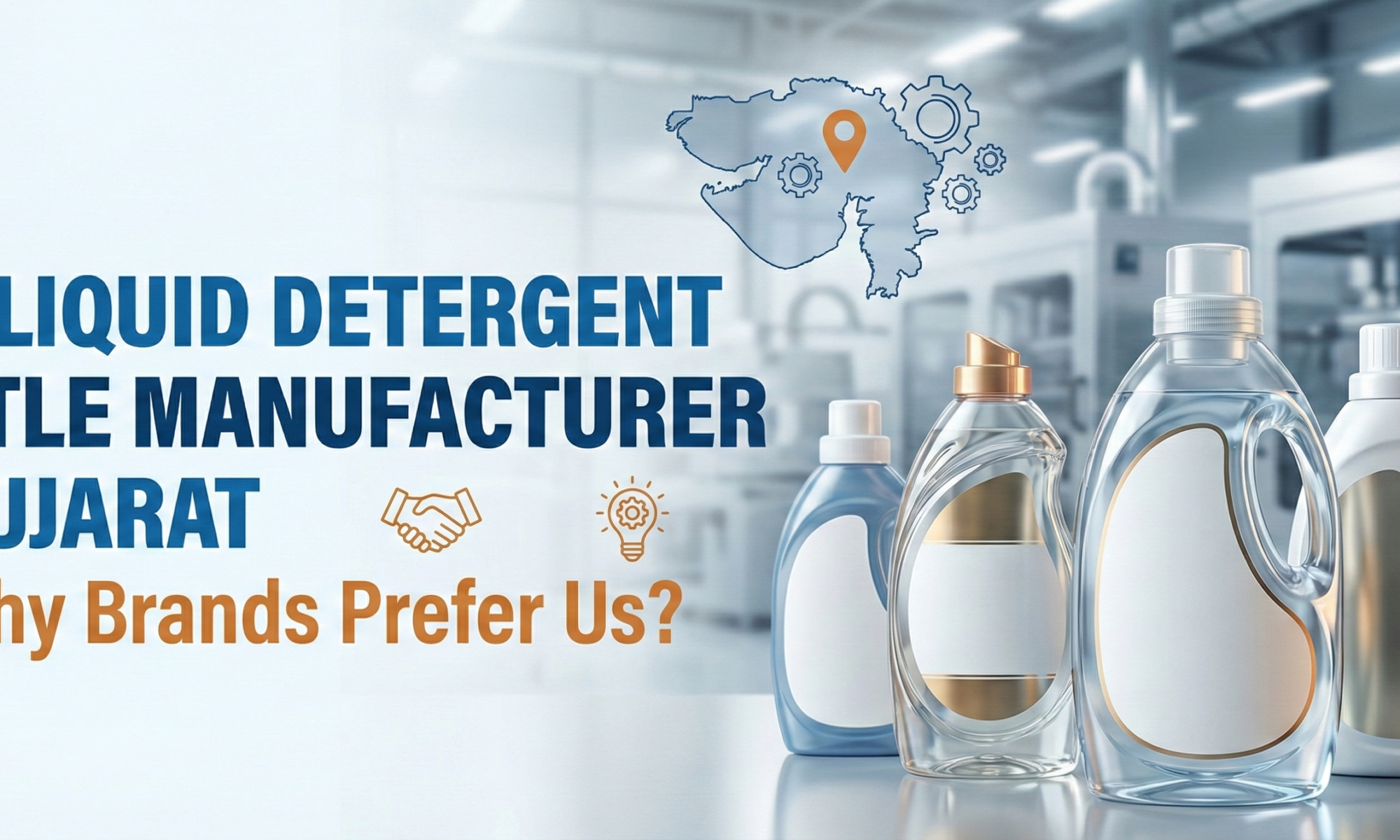
Top Liquid Detergent Bottle Manufacturer in Gujarat — Why Brands Prefer Us?

Introduction

The ease of access to reliable packaging partners isn’t about the availability of moulded plastic components; it is about simplicity in regulatory approvals, consistent delivery, responsive production, and an overall seamless collaboration from design to delivery. In Gujarat, India’s packaging and polymer-manufacturing capital, veteran manufacturers in the industry are able to do all of the above; hence, the reason for the article, Why Brands Prefer Us, and for the practical benefits of doing business with one of the most prominent Liquid Detergent Bottle Manufacturer in Gujarat. Finally, we offer insight into what to consider when evaluating a partnership with a company like Elham MultiPlast LLP.

What These Brands Really Want Out of a Detergent Bottle Supplier

Purchasing brands that buy packaging products in large volumes are somewhat required to meet a very basic supply chain demand. The big requirements from the brands include: * dimensional consistency; leak-proof closures; chemical compatibility for highly concentrated detergents; delivery timelines; and reasonable prices. These are the basic requirements for most brands. Furthermore, for private-label and/or FMCG brands, the packaging is also an essential marketing tool: a better design to an appropriate bottle shape and cap, also has a finish that is appealing, and is less likely to result in products being returned.

This is one of the reasons why the well-known Plastic Bottle Manufacturers in Gujarat concentrated on the above.

Manufacturing excellence: processes that matter

Producing a trustworthy detergent bottle requires more than just forming plastic; it involves overseeing various components of a production chain. Certain key features that distinguish leading suppliers from others include:

Material selection and compatibility

High density polyethylene (HDPE) constitutes the industry standard for liquid detergents because it is lightweight and recyclable, and it maintains surfactants and common solvents. A reputable HDPE detergent bottle supplier in Gujarat will:

1.  Test chemical compatibility (accelerated aging, stress crack resistance).

2. Source grade-certified resins (with traceable batches).

3. Provide different grades of resins for varying costs and performance advantages.

Precision moulding and finish

Blow moulding technologies (single stage, twin screw extrusion, or injection stretch blow moulding for PET) controls neck finish, wall thickness, and cosmetic quality. Reliability of Bulk detergent bottles supplier is ensured by pliable tooling and automated quality control systems that minimize rejects.

Closure and secondary sealing

Cap designs, liner materials, and thread precision influence leak resistance. When suppliers provide tested closures, suggest Torq settings for caps, and include tamper evident indicators, brands can ship with more global confidence.

Quality, Compliance, and Traceability

Companies need to require visible evidence for what? specific to quality systems. The top tier of vendors supplies.

1.  Process Quality Control and Statistical Process Control (SPC) systems at varying stages of the process.

2. Test the packaging and assess it properly (From the packaging, how is the product protected during transportation?).

3. Traceability of batches (resin lot → Mold → finished products).

4. Testing reports (leaks, drops, chemicals).

Packaging and labelling that meet transport regulations.

Quality assurance and total quality management systems have been developed by (for example) Elham MultiPlast LLP in Gujarat. This helps procurement teams process vendor audits and approval of retail and export markets faster.

Customization: Packaging as a Brand Asset

A generic stock bottle functions. Brand specific a bottle increases conversion. Leading Custom HDPE bottles Gujarat suppliers enable.

1. 3D Tooling for rapid prototyping and fast iterations.

2. Co – design of comfortable ergonomic assist handles and closures (child safe).

3. Finish Details: textures, embossing, unique neck shapes, panels that are labelling friendly.

4. Filling advice for co – packing – Headspace control tiers.

What does each provider mean and why is it good?

Example of how procurement can increase value: a mid-sized home-care brand reduced customer complaints by 40% after changing over to a 2-litre bottle with a reinforced handle, better cap sealing, and a new supplier. These are the sort of results procurement teams are hoping to achieve with vendor changes.

Why procurement teams select Elham MultiPlast LLP

A select of competitors to Elham MultiPlast LLP may face the following practical reasons

1. Complete service provision. From standard Liquid detergent bottle manufacturer to Custom HDPE bottles in Gujarat.

2. Located in Gujarat and has the ability to cater to customers throughout India and to customers in overseas markets.

3. Concentration on quality control, timely shipments, and the flexibility to adjust production according to market demand.

4. Knowledge of the market sector which include detergent chemistry, filling-line, and retail.

5. Customer service includes consultations, sample requests, and shipment of products.

6. By already stating the vendor, it shows that procurement has vendor reliability and Elham MultiPlast LLP is a partner that has positioned itself to fulfil such hopes.

Evaluating a potential supplier (practical checklist)

When assessing Liquid detergent packaging solutions vendors, the following procurement checklist can be considered.

1.  Material tests: include the provision of a chemical compatibility and stress-crack test.

2. Process controls: a provision of SPC charts, and the resultant % of nonconformance.

3. Sample program: implementing functional prototypes related to real-world filling and drop tests.

4. Traceability & certification: ISO and environmental claims and documented QC processes.

5. Supply assurance: minimum lead time and safety stock policies, and contingency plans.

6. Cost transparency: unit costs, tooling amortization, minimum order quantities, and freight terms.

If a supplier, say, Elham MultiPlast LLP, can provide these documents and present customer case studies, it is a strong indication that they are procurement-ready.

Conclusion:

Packaging is where a product interacts with the customer. A good packaging partner balances the corners of excellence in production, understanding regulatory requirements, sensitivity in design, and reliability in logistics. For home-care, FMCG, and private label brands, a reputable HDPE detergent bottle supplier in Gujarat can help with faster time to market, reduce complaint rates, and improve shelf presence.

If you are sourcing bottles in bulk, evaluate potential partners based on their technical documentation, rigor in sample-testing, and collaborative design modifications. It makes the procurement decision easier and reduces long-term risk when suppliers combine technical competence with responsive service, such as Elham MultiPlast LLP.


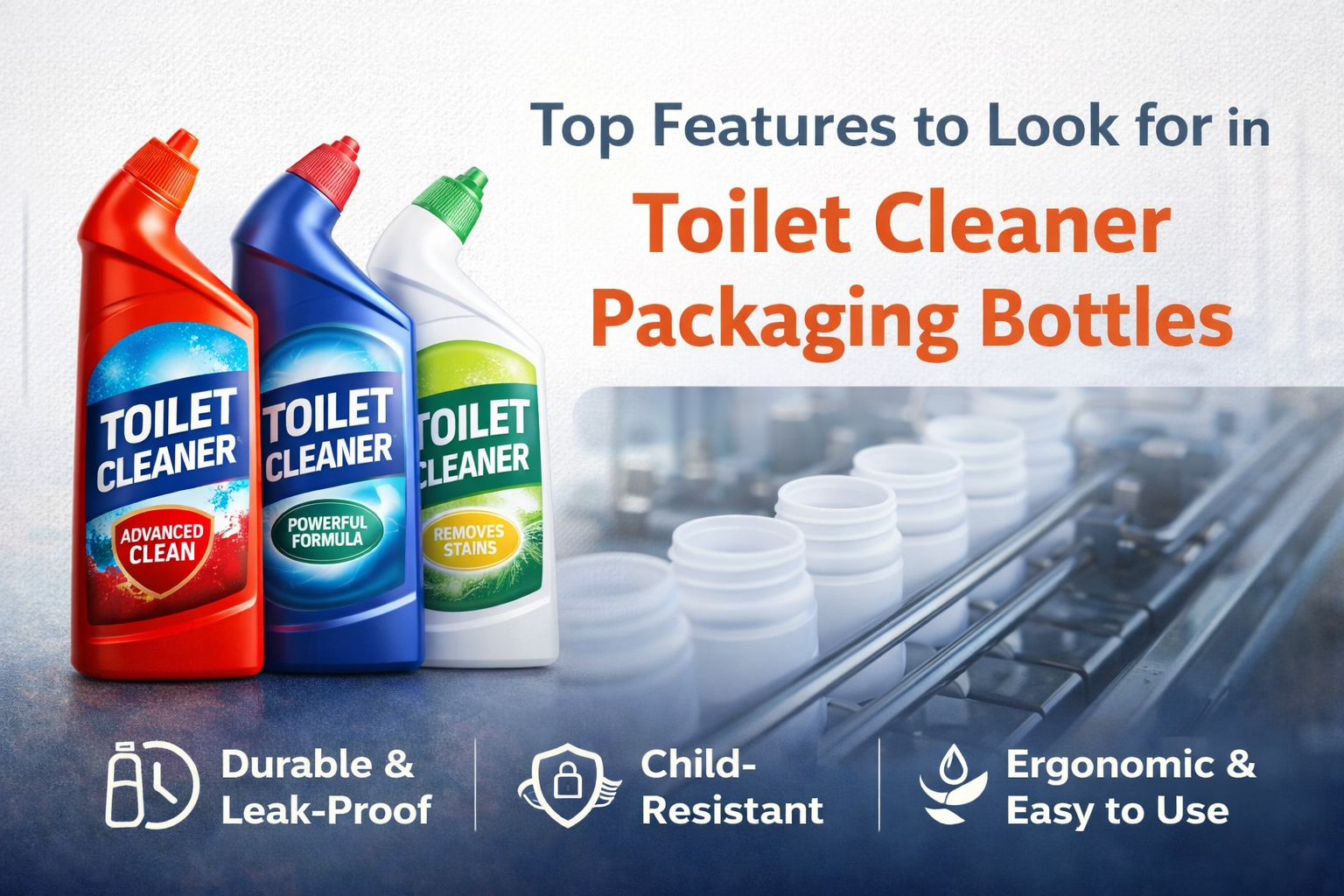
Top Features to Look for in Toilet Cleaner Packaging Bottles

How to best choose packaging for toilet cleaners goes beyond just looks. These considerations also involve safety, shelf life, brand image, logistics optimization, and user experience. For brand managers, packaging engineers, and procurement teams in the home care industry, choosing the right bottle goes beyond the aesthetic and becomes a bigger shot. Below, I list the features to focus on most, explain their operational relevance, and provide actionable assistance based on industry practices and manufacturer knowledge in the field, including Elham MultiPlast LLP.

1. Chemical compatibility and material choice

Why it matters

Toilet cleaners contain strong acids, bleaches, and surfactants that can weaken or react with some types of plastic. Bottles that fail on this front lead to leaking, distortion, or product contamination, and they can lead such consequences to make it extremely expensive.

What to look for

a. Material: HDPE Toilet Cleaner bottles have become standard in the industry because high-density polyethylene withstands a wide range of acids and bases, it is inexpensive, and is highly versatile in terms of formatting.

b. Additives & liners: For highly aggressive formulas, bottles with reinforced walls, custom stabilizers, or liner coatings that are known to be compatible are good for you.

c. Testing: Confirm that your supplier’s bottles have successfully passed tests assessing chemical acceleration, aging, and permeation.

Real-world note: Customers have consistently praised procurement teams who switched from generic containers to purpose-specified HDPE bottles for reduced leakage and discoloration complaints.

2. Leak-proof design and closures

Why it matters

A brand’s first line of defence against leaks is the closure system; therefore, spill-proof packaging saves consumers, retailers, transporters, and the brand’s reputation.

What to look for

a. Tamper-evident seals: For product integrity assurance, this is a market requirement.

b. Child-resistant options: For toilet cleaner concentrates, closures should meet child-safe regulations for your region.

c. Fit and finish: With precision moulding, interlocked necks and caps to reduce cross-threading and calamity micro-gaps.

d. Design features: Integrated drip-catch rings, spouts that are over moulded, and caps with gaskets help create Leak proof packaging for home care.

Example: After a Toilet Cleaner bottle manufacturer supplied a gasketed cap system, a mid-sized home-care brand experienced a decrease in retail return rates due to this effective design.

3. Ergonomics and dispensing control

Why it matters

Bottles should be designed so that a consumer can hold, aim, and dispense with one hand, and the design should be ergonomic to improve safety (fewer slips) and product performance (accurate dosing).

What You Should Be Looking For

a. Grip Features: Dry grips and wet grips will require different handle designs or features, such as grooves, indentations, or a contoured waist.

b. Dispensing Spouts: Dispensing and pouring needs will vary depending on the purpose of a bottle, and different spouts are suited for different purposes – e.g., a flip-top or a controlled- orifice pump for small volumes.

c. Balance: Ergonomic cleaning product bottles will have a wide and stable base, and a neck design that will be perpendicular to the top and will align with the natural wrist motion of the user.

Practical Insight: Before building a foam or plastic injection mold, packaging engineers will often glue 3D-printed necks to a bottle to test the reach and aim of the bottle.

4. Durability and Impact Resistance

Why It Is Important

All packaging types have to endure bottle drops, crushing of the products, and thermal changes that will occur to the product. Products should be impact and abrasion resistant.

What to Look For

a. Wall Thickness Optimization: Consider incorporating reinforced ribs or variable wall sections, as these will increase the strength of the walls without a significant increase in weight to the overall walls.

b. Impact-Modified HDPE Blends: These are in high demand under Durable chemical resistant bottles as these can improve the HDPE drops performance while maintaining the needed chemical resistance.

c. Stress-Relief Features: Add smoothing on the corners and base to reduce high stress locations.

Industry Practice: For bulk order shipments, Elham MultiPlast LLP is one of the most prominent suppliers that performs drop testing as part of their quality assurance.

5. Branding-ready design and surface finish

Why it matters

Packaging is the most visible component of branding and is a touchpoint between the brand and the consumer. A strong branding supported by a shelf-topping bottle will also convey the product benefits more efficiently.

What to look for

a. Flat or sculpted panels that can be used for label placement or direct printing.

b. Matte vs. gloss finishes – think of the brand story, and label materials.

c. Integrated brand cues – harmonized design for brand recognition by use of unique silhouettes, embossing, or tamper bands.

d. Design Flexibility – partner with suppliers that allow HDPE bottle design for branding. This can be through custom moulds or in-mould labelling.

Tip: Actual retail lighting should be used when prototyping to know that the finish and color used will perform well on the shelf.

6. Cost and supply-chain considerations

Why it matters

Price per bottle is important, as are lead times for tooling, minimum order quantise (MOQs), and logistics costs. Total cost of ownership is the most important measure.

What to look for

a. Volume economies – considerations from this perspective often result in reduced unit costs and a more stable supply.

b. Tooling amortization – custom shapes will require a tooling spend. Balance the expected run length against the needs for differentiation.

c. Standard SKUs vs. customization: Custom designs help sharpen differentiation; however, off-the-shelf bottles lead to shorter lead time.

d. Sustainability premium: Recycled-content HDPE qualifies your brand better in terms of positioning and compliance, although it may cost slightly more.

Operational note: Custom label and cap strategies off-set standard base bottle costs; this is a hybrid approach many brands have adopted.

7. Sustainability and recyclability

Why it matters

Sustainably, recyclability, or use of recycled materials in your packaging is expected in today’s market. These factors will influence multiple areas; procurement and marketing will require a re-evaluation, while compliance will need seamless integration.

What to look for

a. Mono-material design: HDPE bottles that are single-polymer are less complicated to recycle than those that are made of multiple materials.

b. Post-consumer recycled (PCR) content: Suppliers can provide HDPE, in proportionate PCR contents, that meets your chemical resistance requirements.

c. Design for disassembly: Avoid multi-materials that are permanently attached, as these can inhibit recycling.

Real-world consideration: Less complicated retail acceptance and more effective recycling program messaging on sustainability labels was reported to have been achieved by a brand that switched to mono-HDPE bottles.

8. Regulatory and labelling readiness

Why it matters

In many regions, toilet cleaners are products that have compliance requirements. Your packaging must enable use of necessary safety instructions, hazard symbols, and batch codes.

Criteria

a. Labels need to be arranged and placed in order to be compliant with regulatory requirements (ingredients, hazard warnings, and directions).

b. Tamper and batch coding compatibility with surfaces that accept ink jet or laser coding.

c. Child-resistant compliance, if necessary, closure systems meet local requirements.


9. Customization and co-development support

Importance

Collaborating with a provider that can co-develop is advantageous as it shortens time-to-market and enhances product-market fit,

What to search for

a. Engineering design assistance, CAD, prototyping, and fill-line testing.

b. Flexible MOQ should be used to support a seamless transition from pilot runs to high-volume production.

c. Quality systems ISO certifications, traceability of materials, and testing documentation.

Supplier insight: Experienced suppliers like Elham MultiPlast LLP can reduce cycle time for development by combining expertise for tooling with guidance on material selection.


Final checklist (quick reference)

a. Chemical compatibility: HDPE or specialized liners.

b. Closures & seals: Leak-proof, tamper-evident, with child-resistant options.

c. Ergonomics: Grip, balanced, dispensing control.

d. Durability: Impacts resistance and optimized wall geometry.

e. Branding: Surface finishing, panels, and silhouettes.

f. Supply chain: MOQ, tooling costs, lead times, bulk supplier options.

g. Sustainability: Mono-material, PCR options.

h. Regulatory: Label space, coding compatibility, compliance.

i. Supplier capability: Prototyping, testing, QA.


Conclusion

Analysing the packaging of toilet cleaners is the intersection of chemistry, engineering, human factors, and brand strategy. Emphasize HDPE Toilet Cleaner bottles since you have chemical sensitivity and Leak proof packaging for home care which is essential for user and logistics safety. Supplier evaluation is both technical and supply chain reliability. Risk and time to market can be greatly reduced by partnering with experienced manufacturers and bulk suppliers, including Elham MultiPlast LLP, for testing, prototyping, and co-development.

As you specify your next bottle, be sure to exercise the checklist on the line above and demand of them test evidence: chemical compatibility reports, drop test, and sampled production. These uncomplicated steps serve to distinguish packaging that contains a product from packaging that protects the brand and improves user experience.

Dedicated Manufacturing Model: The Future of HDPE Bottle Production in India

The packaging industry in India is evolving rapidly, with companies looking for smarter, more efficient ways to meet their increasing demand for reliable and consistent supply. Among these advancements, the Dedicated Manufacturing Model introduced by Elham MultiPlast LLP is redefining how brands approach HDPE bottle production and bulk packaging solutions.

Understanding the Dedicated Manufacturing Model

The Dedicated Manufacturing Model is designed for companies that require continuous, large-scale packaging production. Instead of relying on shared resources or limited production slots, Elham MultiPlast LLP provides an exclusive setup—either at our state-of-the-art facilities in Himatnagar and Surat (Gujarat) or directly at the client’s location.

This model ensures that the entire production line—machines, moulds, and manpower—is dedicated to one client’s requirements, guaranteeing round-the-clock manufacturing efficiency and quality consistency.

Why the Dedicated Manufacturing Model is the Future of HDPE Bottle Production

1. Continuous Supply and Reliability

Businesses in sectors like home care, FMCG, agrochemicals, lubricants, veterinary, pharma, and edible oils often face unpredictable demand. With a dedicated production setup, clients benefit from 24/7 output, ensuring they never run out of stock or face downtime.

2. Customization and Flexibility

Whether it’s HDPE bottles, plastic jerry cans, or closures, every product can be customised according to exact client specifications—from shape and size to thickness and labelling compatibility. This flexibility helps brands maintain uniformity and a strong visual identity across all packaging.

3. Cost and Resource Efficiency

By streamlining production at one dedicated site, businesses save on logistics, warehousing, and transportation costs. The Dedicated Manufacturing Model also reduces lead times and ensures efficient use of raw materials and labour, improving overall cost-effectiveness.

4. Enhanced Quality Control

Quality is non-negotiable for Elham MultiPlast LLP. Dedicated production means strict monitoring, cleaner production environments, and consistent quality checks at every stage — from raw material to final packaging. Each bottle meets the highest safety and performance standards, including IS 11584:1986 and IS 10171:1999 certifications.

5. Operational Transparency

Clients get complete visibility of their production schedules, output volumes, and delivery timelines. This open process builds trust and long-term partnerships based on accountability and shared growth.

Applications Across Industries

Our Dedicated Manufacturing Model is ideal for brands with large, consistent packaging requirements in:

  1. Home Care Products – Toilet cleaner bottles, liquid detergent bottles, floor cleaner bottles

  2. AgrochemicalsHDPE pesticide bottles, agrochemical jerrycans

  3. FMCG & Edible Oils – Food-grade HDPE and PET bottles

  4. Lubricants & Automotive – Sturdy jerrycans and oil containers

  5. Pharmaceutical & Veterinary – Medical-grade HDPE packaging solutions

Whether you need a liquid detergent bottle supplier, toilet cleaner bottle manufacturer, or plastic jerry can manufacturer, Elham MultiPlast LLP provides everything under one roof with unmatched precision.

Why Partner with Elham MultiPlast LLP?

  • Exclusive Production Setup – 100% dedicated to your brand’s needs

  • Advanced Machinery – State-of-the-art plants in Himatnagar & Surat

  • Innovation-Focused Approach – R&D-driven moulds and product design

  • Trusted by Industry Leaders – Supplying to top brands like Hindustan Unilever, DSM, Dabur, and Vicco

  • On-Time Delivery – Continuous production ensures seamless supply chain support

Conclusion

As the demand for durable and sustainable packaging grows, the Dedicated Manufacturing Model is becoming the cornerstone of the HDPE bottle production industry in India. With advanced infrastructure, technical expertise, and customer-centric innovation, Elham MultiPlast LLP is leading the way for brands seeking reliability, scalability, and quality in every bottle.

📞 Let’s discuss your bulk packaging requirements today!
📧 sales@elhammultiplast.com | 🌐 www.elhammultiplast.com | 📱 +91 97246 08450

Dedicated Manufacturing Model for Requirements in Bulk Packaging

Elham MultiPlast LLP is aware of the growing need for dependable, extensive packaging supplies in industries such as Home Care, FMCG, agrochemicals, lubricants, veterinary care, pharma, edible oils, etc. We now offer a Dedicated Manufacturing Model, a solution made for companies with a steady, high demand for bottles, cans, jars, and closures, in order to better satisfy these demands.

Our Dedicated Model
1.⁠ ⁠We offer the choice to set up specialised production equipment either at our own facilities, where labour, moulds, and machines are all directed towards the client’s requirements,
or
2.⁠ ⁠on the client’s location, offering direct integration with their packaging line.

Principal Advantages
Assurance of Round-the-Clock Production: Continuous production to ensure a consistent supply.
Customised Configuration: Moulds, dimensions, and specifications were changed to meet exact specifications.
Expense Efficiency: Improved resource allocation and reduced transportation costs.
Quality Control: Consistent quality and cleanliness are ensured by designated pathways.
Operational Transparency: Customers are able to monitor production and delivery schedules in great detail.

Mandatory Requirements
Clients are responsible for managing the entire manufacturing output around the clock because equipment and resources are exclusively assigned. For companies with large and constant packaging needs, this approach is ideal.

Collaborate with Elham MultiPlast LLP
Equipped with advanced facilities in Himatnagar and Surat ( Gujarat ) and a successful history of dependable packaging production, Elham MultiPlast LLP is poised to be your enduring ally in development.

Numerous esteemed brands in India, such as Hindustan Unilever, DSM, Dabur, Vicco, and many more, already place their trust in us.

📞 Let’s talk about your specific production requirements.
📧 sales@elhammultiplast.com  | 🌐 www.elhammultiplast.com  | 📱 +91 97246 08450

Full Container Load (FCL) — The Smart Choice for Bulk Bottle Deliveries

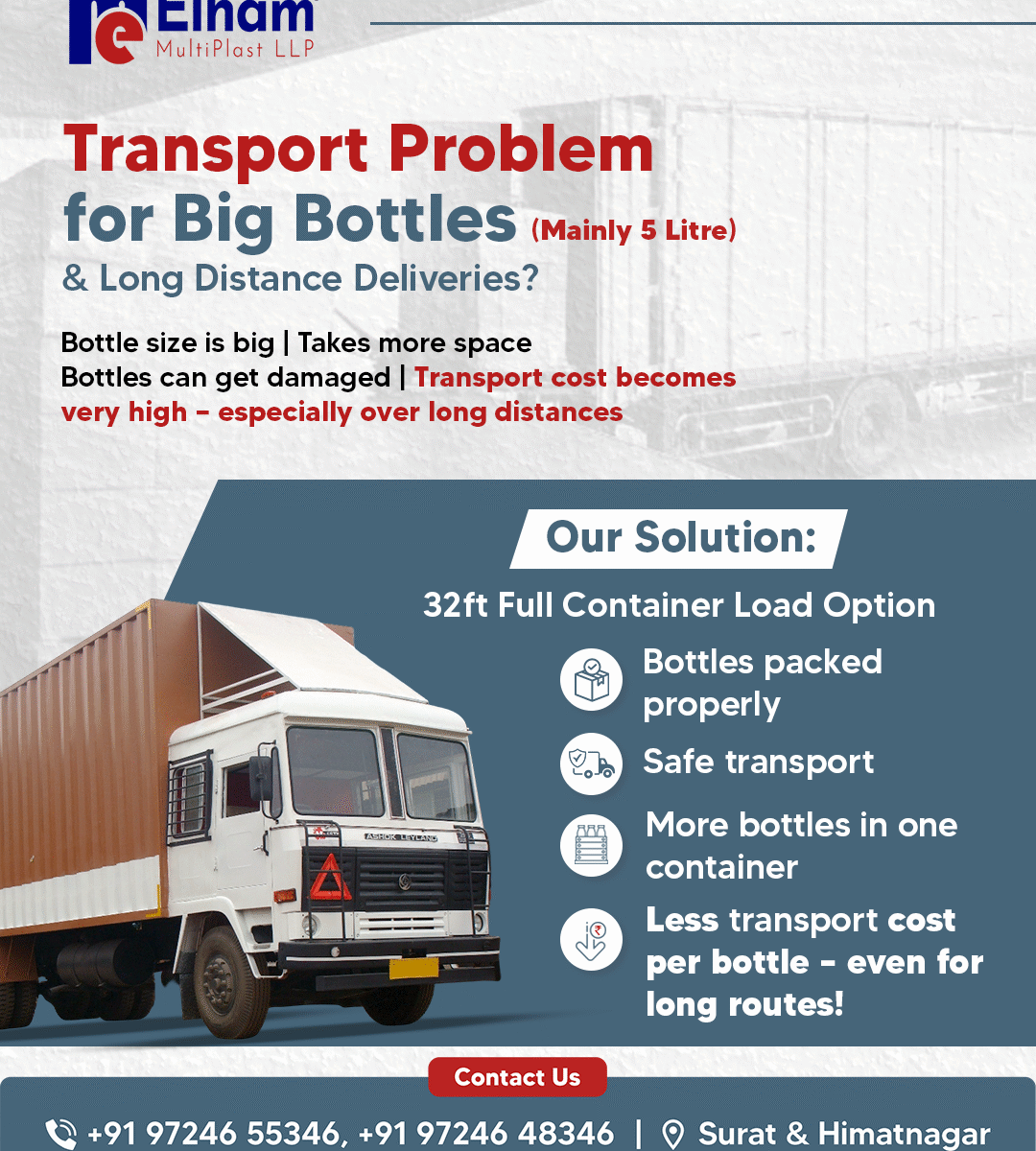
Long-distance plastic bottle transportation has always been difficult, especially for larger bottles that are more than five litres.

Logistics are complicated and expensive because of issues like rising transportation costs, inefficient use of space, and damage sustained during transit.

We at Elham MultiPlast LLP are aware of these challenges and offer a workable solution:

Complete Shipping Option for Container Load (FCL)

Now, you have the option to have your bottles or cans delivered straight from our factory in 20-, 32-, or 40-foot containers.

Motives for Choosing the FCL Option
✅ Safe Shipping: Cans and bottles are securely sealed to prevent damage while in transit.
✅ Enhanced Loading: We maximize space efficiency by fitting more bottles per container.
✅ Lower Freight Cost: Even on long routes, the cost of transportation per bottle drops significantly.
✅ Efficient Large-Scale Shipping: Ideal for customers who prefer full truck or container deliveries.

Clients in the home care, agrochemical, lubricant, veterinary, pharmaceutical, edible oil, and FMCG industries—particularly those requiring big containers (5L and beyond) or bulk shipments to remote locations—will find this model especially suitable.

Elham MultiPlast LLP ensures that your bulk packaging is supplied safely, effectively, and economically. With facilities in Himatnagar and Surat (Gujarat), the company is trusted by businesses like Hindustan Unilever, DSM, Dabur, and Vicco.

📞 Let’s plan your upcoming FCL shipment.
📧 sales@elhammultiplast.com
🌐 www.elhammultiplast.com
📱 +91 97246 55346