Leak proof packaging for home care — Testing Standards Followed by Gujarat Manufacturers Serving Delhi
January 31, 2026
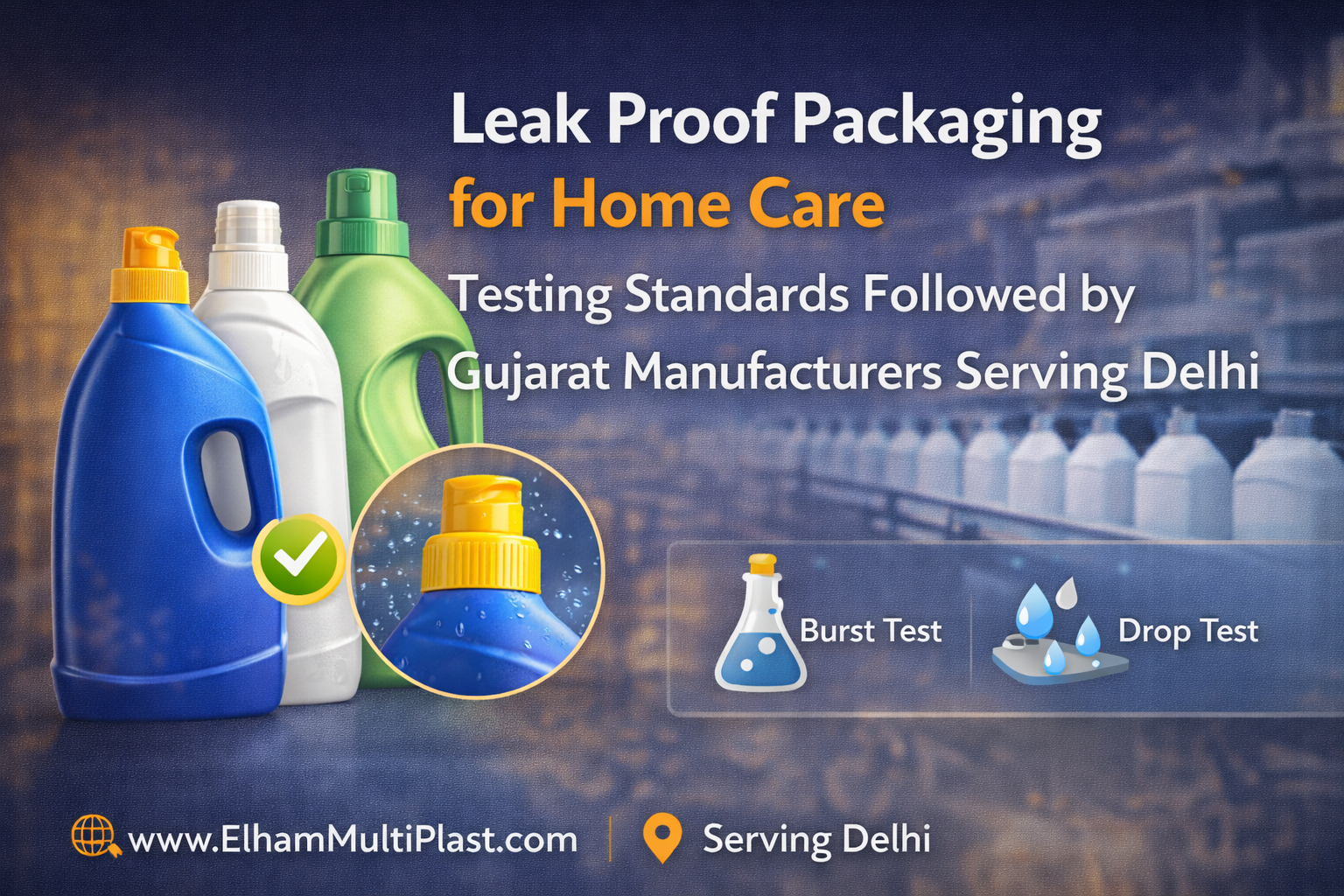
More than just an inconvenience, leakage destroys shelf appeal, endangers the safety of consumers, attracts complaints, and leads to expensive returns at every level of distribution. When sourcing bottles for detergents, surface cleaners, phenyls and other household chemicals, procurement managers, quality heads and brand owners need to find packaging that withstands the rigors of manufacture, storage, last-mile transit, end-user handling, and then some.
The Elham MultiPlast LLP example demonstrates that manufacturers from Gujarat’s packaging cluster (which constitutes a significant portion of India’s packaging for the home-care segment) are able to assist Delhi’s FMCG market in the construction of modifiable HDPE and PET containers at an economically and productively balanced tier. The difference between a good supplier and a great one is the extensiveness and transparency of their leak-proof testing.
Most Important Tests Needed to Label Packaging as Leak-Proof.
Any supplier servicing the Delhi market would need to run and provide some documentation for the following testing categories—these are all within the Indian standards and the guidelines set for the manufacturers in Gujarat.
Visual and Dimensional Inspection
Each batch begins with simple checks for wall thickness, neck finish, mouth concentricity and closure fit. Aligning measurements helps avoid stress points that will later create leaks. While Indian Standards specify assessments and measurement checks for liquid polyethylene containers, checks should be conducted for all containers.
Closure Retention and Torque Testing
Even a perfect body of a bottle will still leak if a cap is not torqued correctly. Closure Torque tests determine the loosening and tightening torques (also called initial application torque and conditioning retention torque). Today’s torque testers are capable of producing repeatable and auditable tests that can be used as acceptance criteria for procurement contracts. Most tech labs use ASTM-style torque tests.
Mechanical (Pressure/Vacuum/Bubble) Leakage Tests
Pressurization and vacuum techniques, verified with a soap and water bubble test for small containers, are used for leak detection. These tests reveal micro-channels at seals, liner failures, or closures that are not fully seated. Closure leak and pressure-tightness tests are among the Indian test protocols for liquid containers that include compliance with the tests for plastic containers.
Mechanical Shock and Transit Simulation (Drop, Vibration, Compression)
A bottle may be sealed at the factory and still leak after transit.
ISTA regulations (like the ISTA 1A/3A family, which parcel shippers use) simulate the impacts of drops, shakes and compressions during parcel processing and retail handling. These simulations are vital for e-commerce and for the modern distribution of goods to Delhi. Suppliers, who qualify their prepackaged goods using ISTA methods, will experience fewer failures in the marketplace.
Chemical compatibility and soak testing
Home care liquids can be aggressive due to their high alkalinity, presence of solvents, and overall surfactant use. Soak testing, as well as compatibility testing, involve immersion (at room and raised temperatures) for specific time periods. Testing will confirm that there is no unsatisfactory swelling, crazing, color bleeding, or loss of performance from seals. With commodity HDPE, the fluorination or barrier treatments may be necessary for aggressive chemistries. These methods are covered under the Indian standards for specialized HDPE containers.
Accelerated ageing and environmental conditioning
Packaging designed for Indian Warehouses that is meant for use over multiple seasons must be able to withstand and function optimally during Hot and humid weather, periods of intense cold, and thermal shocks. The method of accelerated ageing, which includes exposure to elevated temperatures and cycles of high humidity, is used to assess and evaluate the long-term integrity of seals and the potential for cap torque drift. How manufacturers in Gujarat operationalize these tests Gujarat’s manufacturers usually take the above-mentioned testing categories and turn them into an operational QA matrix for procurement teams. This matrix should be requested and reviewed before final approval.
Sampling and acceptance standards
The BIS/Indian standards outline the rules concerning the sampling of lots, types of tests (destructive and non-destructive), and the acceptance of defects. A good supplier will provide the sampling plan (for instance, 2% of the lot as per IS sampling tables) and the test results for every lot they ship.
Quality control Checkpoints
Good plants provide inline visual/torque check and run destructive tests (burst, tensile of closures, seam peel) on a schedule, if offline is done. Elham MultiPlast LLP and other mature suppliers from Gujarat combine inline monitoring with timely scheduled lab tests so that the earliest drifts prompt early corrective measures before complete lots are released.
Certification of third parties and laboratories
Brands dealing with higher risk home care chemistries, request third party lab reports for the leaks and chemical compatibility. A lot of buyers from Delhi request ISTA lab reports for transit simulation, and torque and leak certifications from NABL accredited labs. A report from a reputable lab, accompanying the shipment, minimizes the disputes during receipt.
More buyer practical acceptance criteria
Procurement teams should consider tests with the go/no-go approach. A couple of practical suggestions:
1. Closure torque: Average retention and standard deviation with retention within X% after conditioning. Define X in the PO. Use calibrated standard.
2. Leakage: No visible leakage at specified pressure/vacuum with the whole sample. Define parameters for the soap-bubble detection (size and time) for the sample.
3. Transit simulation: No structural failure or leakage per the agreed ISTA procedure (Specify the ISTA procedure in the contract).
4. Chemical soak: No visible degradation, mass change or cap-seal failure after the agreed soak (time/temp/chemical concentration documented).
Integrate these in the technical specification (TS) and incoming QC at your Delhi warehouse
Real-world examples and lessons learned
1. Missing torque Control Leads to Consumer Returns. A mid-sized FMCG brand tracked a 2% return rate due to closures being too loose. Result of the manual capping was without torque control. Supplier invested in an automatic torque-applicator and torquing certificates, return rate dropped to near zero.
2. E-commerce transit shows weak seals. A brand’s online marketplace sold product(s) that garnered complaint(s) due to customer receiving product(s) with cap stain(s). Leakage complaint(s) ISTA 3A testing identified a design flaw in closure liner compression drop(s). A simple geometry modification to the neck finish resolved the problem. ISTA pre-qualification certifications eliminated the potential of future SKU failures.
3. Chemically induced material improvements. A detergent with a solvent booster was determined to have an acceptable shelf life only with fluorinated HDPE or a liner. Field discoloration and overall packaging failure was avoided by the buyer and the manufacturer collaboration (materials trial + soak testing). Fluorination and like treatments are considered and are in the standards of the BIS materials guidance.
These are simple examples of why a strong and comprehensive a comment QA process, clearly stated TS documents, and testing transparency overshadow the lowest piece per unit price.
Procurement checklist for Delhi buyers (quick version)
1. Ask for QC matrix and sampling plan (BIS alignment if applicable).
2. Torque reports and calibrated instrument details.
3. Reports per specified ISTA protocol for e-commerce or interstate distribution.
4. Chemical compatibility and soak test (concentration, temp, time) data.
5. Certificates from third parties for critical SKUs (preferably NABL labs)
6. Unambiguous remediation and recall clauses linked to documented shortcomings.
Working with Gujarat suppliers like Elham MultiPlast LLP
When you source from Gujarat, select partners who will collaborate on spec development, pre-qualification runs, and joint testing. Elham MultiPlast LLP — as a Gujarat supplier — exemplifies a partnership model: prototype runs, collaborative ISTA sample runs, and real-time torque/leak test reporting on each approved lot. That level of transparency and capacity is what Delhi procurement teams need most.
When you onboard, conduct a pilot batch, and request lab reports. From supplier promises to quantifiable accountability, these steps are a primary tool.
Final note: standards, documentation, and risk mitigation
Indian and international standards collectively provide the basis for a defendable leak-proof packaging standard. BIS provides the standards, GUIDES the sampling and testing, and ISTA and industry torque/test methods provide the testing and industry simulation. Use all of them together and demand documented testing to minimize the chances of failure once the product is delivered to the market.
Quality assurance is a collaborative effort, and all aspects of the design, the materials, the tooling, the capping, and the distribution the packaging. For Delhi’s demanding home-care market, the outcomes are best with suppliers who thoroughly test and share their findings. Manufacturers from Gujarat, like Elham MultiPlast LLP that observe these principles, help brands minimize product returns, provide for the safety of the consumers, and sustain profit margins.
Leak proof packaging for home care — Testing Standards Followed by Gujarat Manufacturers Serving Delhi
January 31, 2026

Selecting an HDPE bottle supplier in Hyderabad’s Personal Care Market
January 28, 2026

Sourcing an HDPE detergent bottle supplier for Mumbai FMCG lines
January 26, 2026

Liquid Detergent & Home Care Packaging Supplier in Maharashtra
January 5, 2026
Why HDPE Floor Cleaner Bottles Are the Most Reliable Choice for Home Care Brands?
January 1, 2026

Top Liquid Detergent Bottle Manufacturer in Gujarat — Why Brands Prefer Us?
January 1, 2026