Leak proof packaging for home care — Testing Standards Followed by Gujarat Manufacturers Serving Delhi
January 31, 2026
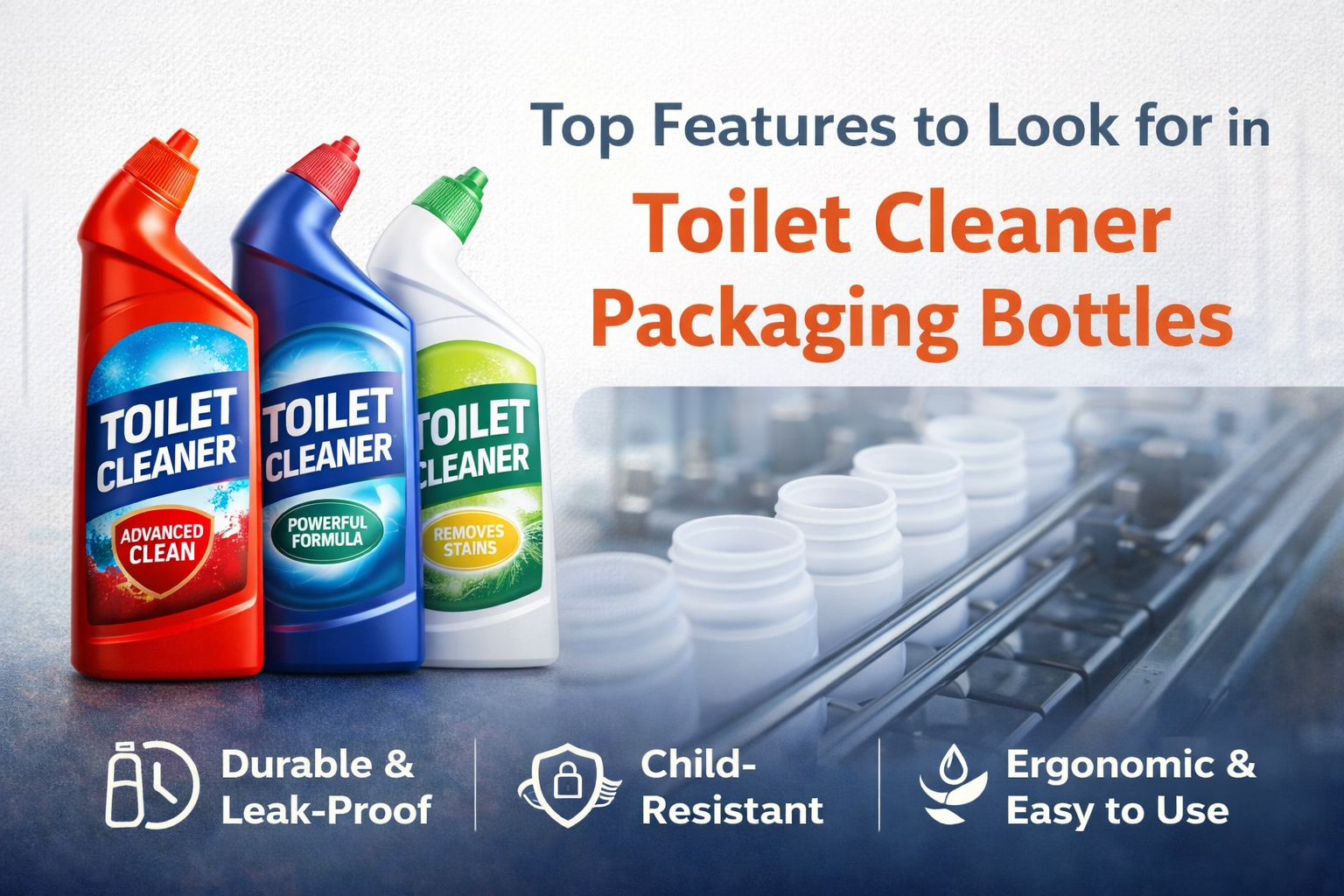
How to best choose packaging for toilet cleaners goes beyond just looks. These considerations also involve safety, shelf life, brand image, logistics optimization, and user experience. For brand managers, packaging engineers, and procurement teams in the home care industry, choosing the right bottle goes beyond the aesthetic and becomes a bigger shot. Below, I list the features to focus on most, explain their operational relevance, and provide actionable assistance based on industry practices and manufacturer knowledge in the field, including Elham MultiPlast LLP.
Toilet cleaners contain strong acids, bleaches, and surfactants that can weaken or react with some types of plastic. Bottles that fail on this front lead to leaking, distortion, or product contamination, and they can lead such consequences to make it extremely expensive.
a. Material: HDPE Toilet Cleaner bottles have become standard in the industry because high-density polyethylene withstands a wide range of acids and bases, it is inexpensive, and is highly versatile in terms of formatting.
b. Additives & liners: For highly aggressive formulas, bottles with reinforced walls, custom stabilizers, or liner coatings that are known to be compatible are good for you.
c. Testing: Confirm that your supplier’s bottles have successfully passed tests assessing chemical acceleration, aging, and permeation.
Real-world note: Customers have consistently praised procurement teams who switched from generic containers to purpose-specified HDPE bottles for reduced leakage and discoloration complaints.
A brand’s first line of defence against leaks is the closure system; therefore, spill-proof packaging saves consumers, retailers, transporters, and the brand’s reputation.
a. Tamper-evident seals: For product integrity assurance, this is a market requirement.
b. Child-resistant options: For toilet cleaner concentrates, closures should meet child-safe regulations for your region.
c. Fit and finish: With precision moulding, interlocked necks and caps to reduce cross-threading and calamity micro-gaps.
d. Design features: Integrated drip-catch rings, spouts that are over moulded, and caps with gaskets help create Leak proof packaging for home care.
Example: After a Toilet Cleaner bottle manufacturer supplied a gasketed cap system, a mid-sized home-care brand experienced a decrease in retail return rates due to this effective design.
Bottles should be designed so that a consumer can hold, aim, and dispense with one hand, and the design should be ergonomic to improve safety (fewer slips) and product performance (accurate dosing).
a. Grip Features: Dry grips and wet grips will require different handle designs or features, such as grooves, indentations, or a contoured waist.
b. Dispensing Spouts: Dispensing and pouring needs will vary depending on the purpose of a bottle, and different spouts are suited for different purposes – e.g., a flip-top or a controlled- orifice pump for small volumes.
c. Balance: Ergonomic cleaning product bottles will have a wide and stable base, and a neck design that will be perpendicular to the top and will align with the natural wrist motion of the user.
Practical Insight: Before building a foam or plastic injection mold, packaging engineers will often glue 3D-printed necks to a bottle to test the reach and aim of the bottle.
All packaging types have to endure bottle drops, crushing of the products, and thermal changes that will occur to the product. Products should be impact and abrasion resistant.
a. Wall Thickness Optimization: Consider incorporating reinforced ribs or variable wall sections, as these will increase the strength of the walls without a significant increase in weight to the overall walls.
b. Impact-Modified HDPE Blends: These are in high demand under Durable chemical resistant bottles as these can improve the HDPE drops performance while maintaining the needed chemical resistance.
c. Stress-Relief Features: Add smoothing on the corners and base to reduce high stress locations.
Industry Practice: For bulk order shipments, Elham MultiPlast LLP is one of the most prominent suppliers that performs drop testing as part of their quality assurance.
Packaging is the most visible component of branding and is a touchpoint between the brand and the consumer. A strong branding supported by a shelf-topping bottle will also convey the product benefits more efficiently.
a. Flat or sculpted panels that can be used for label placement or direct printing.
b. Matte vs. gloss finishes – think of the brand story, and label materials.
c. Integrated brand cues – harmonized design for brand recognition by use of unique silhouettes, embossing, or tamper bands.
d. Design Flexibility – partner with suppliers that allow HDPE bottle design for branding. This can be through custom moulds or in-mould labelling.
Tip: Actual retail lighting should be used when prototyping to know that the finish and color used will perform well on the shelf.
Price per bottle is important, as are lead times for tooling, minimum order quantise (MOQs), and logistics costs. Total cost of ownership is the most important measure.
a. Volume economies – considerations from this perspective often result in reduced unit costs and a more stable supply.
b. Tooling amortization – custom shapes will require a tooling spend. Balance the expected run length against the needs for differentiation.
c. Standard SKUs vs. customization: Custom designs help sharpen differentiation; however, off-the-shelf bottles lead to shorter lead time.
d. Sustainability premium: Recycled-content HDPE qualifies your brand better in terms of positioning and compliance, although it may cost slightly more.
Operational note: Custom label and cap strategies off-set standard base bottle costs; this is a hybrid approach many brands have adopted.
Sustainably, recyclability, or use of recycled materials in your packaging is expected in today’s market. These factors will influence multiple areas; procurement and marketing will require a re-evaluation, while compliance will need seamless integration.
a. Mono-material design: HDPE bottles that are single-polymer are less complicated to recycle than those that are made of multiple materials.
b. Post-consumer recycled (PCR) content: Suppliers can provide HDPE, in proportionate PCR contents, that meets your chemical resistance requirements.
c. Design for disassembly: Avoid multi-materials that are permanently attached, as these can inhibit recycling.
Real-world consideration: Less complicated retail acceptance and more effective recycling program messaging on sustainability labels was reported to have been achieved by a brand that switched to mono-HDPE bottles.
In many regions, toilet cleaners are products that have compliance requirements. Your packaging must enable use of necessary safety instructions, hazard symbols, and batch codes.
a. Labels need to be arranged and placed in order to be compliant with regulatory requirements (ingredients, hazard warnings, and directions).
b. Tamper and batch coding compatibility with surfaces that accept ink jet or laser coding.
c. Child-resistant compliance, if necessary, closure systems meet local requirements.
Collaborating with a provider that can co-develop is advantageous as it shortens time-to-market and enhances product-market fit,
a. Engineering design assistance, CAD, prototyping, and fill-line testing.
b. Flexible MOQ should be used to support a seamless transition from pilot runs to high-volume production.
c. Quality systems ISO certifications, traceability of materials, and testing documentation.
Supplier insight: Experienced suppliers like Elham MultiPlast LLP can reduce cycle time for development by combining expertise for tooling with guidance on material selection.
a. Chemical compatibility: HDPE or specialized liners.
b. Closures & seals: Leak-proof, tamper-evident, with child-resistant options.
c. Ergonomics: Grip, balanced, dispensing control.
d. Durability: Impacts resistance and optimized wall geometry.
e. Branding: Surface finishing, panels, and silhouettes.
f. Supply chain: MOQ, tooling costs, lead times, bulk supplier options.
g. Sustainability: Mono-material, PCR options.
h. Regulatory: Label space, coding compatibility, compliance.
i. Supplier capability: Prototyping, testing, QA.
Analysing the packaging of toilet cleaners is the intersection of chemistry, engineering, human factors, and brand strategy. Emphasize HDPE Toilet Cleaner bottles since you have chemical sensitivity and Leak proof packaging for home care which is essential for user and logistics safety. Supplier evaluation is both technical and supply chain reliability. Risk and time to market can be greatly reduced by partnering with experienced manufacturers and bulk suppliers, including Elham MultiPlast LLP, for testing, prototyping, and co-development.
As you specify your next bottle, be sure to exercise the checklist on the line above and demand of them test evidence: chemical compatibility reports, drop test, and sampled production. These uncomplicated steps serve to distinguish packaging that contains a product from packaging that protects the brand and improves user experience.
Leak proof packaging for home care — Testing Standards Followed by Gujarat Manufacturers Serving Delhi
January 31, 2026
Selecting an HDPE bottle supplier in Hyderabad’s Personal Care Market
January 28, 2026

Sourcing an HDPE detergent bottle supplier for Mumbai FMCG lines
January 26, 2026

Liquid Detergent & Home Care Packaging Supplier in Maharashtra
January 5, 2026
Why HDPE Floor Cleaner Bottles Are the Most Reliable Choice for Home Care Brands?
January 1, 2026

Top Liquid Detergent Bottle Manufacturer in Gujarat — Why Brands Prefer Us?
January 1, 2026