Plastic Jars for Every Industry: Uses, Sizes and Benefits
October 5, 2026
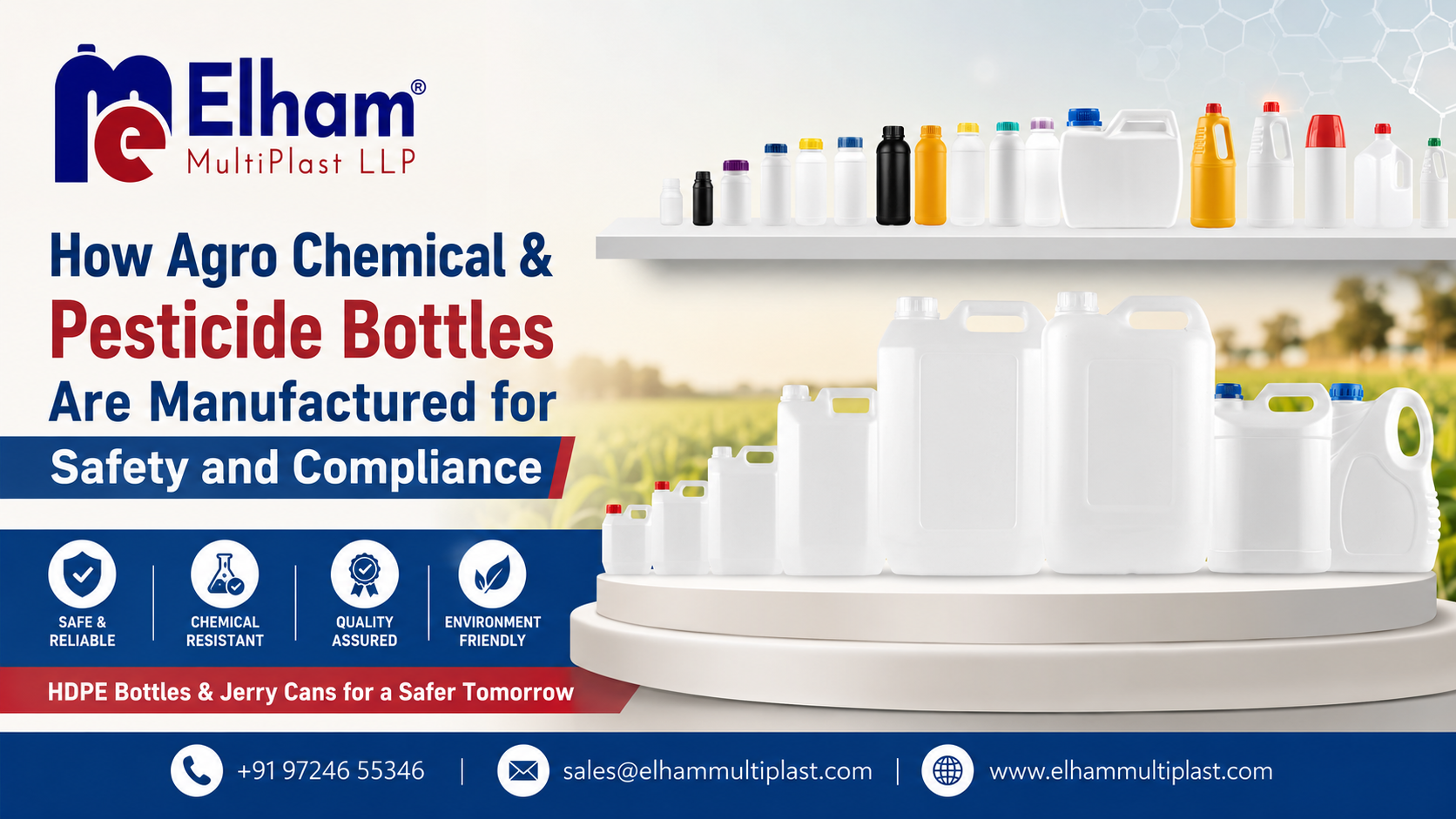
Agrochemical bottles are made from UV-stable, virgin-grade HDPE through extrusion blow moulding, then leak-tested, chemical-tested, and labelled to meet CIBRC and Insecticides Rules, 1971 requirements before they ever reach a formulation line. This guide is written for agrochemical manufacturers, pesticide brands, and packaging procurement teams who are evaluating an HDPE bottle supplier and want to understand what separates a compliant, field-ready bottle from one that only looks the part.
Who This Guide Is For
This article is written for three groups: agrochemical and pesticide manufacturers sourcing or switching packaging suppliers, procurement teams benchmarking a HDPE bottles manufacturer or PET bottles manufacturer against technical criteria rather than price alone, and contract packers or private-label brands who need to understand compliance obligations before a product launch. If you are trying to decide whether a supplier’s claims about durability and compliance are real, the sections below explain exactly what to check.
Why Agrochemical Bottle Manufacturing Is Different from Ordinary Plastic Bottles
Short answer: agrochemical bottles have to survive aggressive chemistry, satisfy a specific regulatory framework, and take physical abuse that most consumer packaging never faces, which is why the manufacturing process is more tightly controlled than for bottles used in food or personal care.
Most consumer bottles only need to hold their shape and look good on a shelf. Agrochemical bottles have to do that plus resist active ingredients that are acidic, alkaline, solvent-based, or a mix of all three, often at concentrations that would degrade an ordinary container within weeks.
Chemical Aggression from the Contents
Herbicides, fungicides, and insecticides frequently contain solvents and surfactants that attack plastic at a molecular level, causing softening, stress cracking, or slow permeation through the wall.
Regulatory Obligation, Not Just Brand Preference
In India, insecticides fall under the Insecticides Act, 1968 and the Insecticides Rules, 1971, administered by the Central Insecticides Board and Registration Committee (CIBRC). Packaging is part of what gets scrutinised during product registration, and a container that does not hold up can render a formulation “misbranded” even when the chemistry itself is sound.
Field Abuse the Bottle Cannot Avoid
Bottles travel by truck over rough rural roads, sit in unshaded warehouses through summer heat, and get handled by farm workers who are not always gentle. The packaging has to absorb that abuse so the chemical inside stays contained.
This combination of chemical resistance, legal compliance, and physical durability is why choosing a pesticide bottle manufacturer needs more scrutiny than choosing a bottle for shampoo or juice.
The Manufacturing Journey: From Resin to Finished Bottle
Short answer: production runs through six stages, resin selection, blow moulding, closure engineering, quality testing, regulatory labelling, and palletised dispatch, and a weak link at any single stage can undo the reliability built into the others.
Everything starts with the raw material. Not all HDPE is equal, and using the wrong grade is the single most common reason agrochemical bottles fail in the field.
Virgin-grade HDPE is preferred for primary agrochemical packaging because it offers predictable chemical resistance and consistent melt behaviour, which matters when wall thickness has to stay uniform across thousands of bottles in a single production run.
UV stabilisers are compounded into the resin at this stage. Since most agrochemical bottles are stored outdoors or in semi-open warehouses, UV-stable HDPE prevents the embrittlement and colour fading that would otherwise weaken the bottle within a single season.
Barrier considerations come into play for aggressive or volatile formulations. Multilayer co-extrusion, where a thin EVOH (ethylene vinyl alcohol) layer is sandwiched between HDPE layers, blocks solvent vapour transmission and keeps oxygen from degrading sensitive active ingredients over a longer shelf life. Not every product needs this, but for solvent-heavy formulations it is increasingly standard.
Every batch of incoming resin should be checked against its certificate of analysis before it reaches the hopper. This traceability step is what allows a manufacturer to answer, months later, exactly which resin lot went into a specific batch of bottles if a complaint ever comes in.
Agrochemical bottles are almost always produced using extrusion blow moulding (EBM), the process best suited to the mid-size, thick-walled containers this industry needs.
A heated tube of molten HDPE, called a parison, is extruded downward between two open mould halves.
The mould closes around the parison, and compressed air is blown into it, forcing the plastic against the mould walls until it takes the exact shape of the cavity, including the neck finish, handle, and base.
The mould is water-cooled, so the plastic solidifies quickly enough to hold its shape before it is ejected.
Excess plastic, known as flash, is trimmed away, and the bottle moves to the next station for inspection.
Two details matter more in agrochemical production than in most other bottle categories. First, wall thickness uniformity: parison programming controls how the wall thickness varies along the bottle’s height, and thin spots become the weak points where a stress crack or a slow leak eventually starts. Second, neck finish precision: the neck has to be dimensionally exact so that caps, induction seals, and child-resistant or tamper-evident closures seat correctly every single time. A neck that is even slightly out of tolerance is a leak waiting to happen after transport vibration works it loose.
The bottle body only does half the job. Closures are where most real-world leaks and spills actually originate.
Induction-sealed liners create a hermetic seal across the bottle mouth that has to be physically broken before first use, which is both a leak barrier and a tamper-evidence feature.
Vented caps or vented liners are used for larger fill volumes and for formulations that off-gas slightly during storage, preventing the bottle from buckling or, in warmer conditions, ballooning under internal pressure.
Child-resistant closures are increasingly requested for products with higher toxicity ratings, adding a mechanical barrier against accidental access.
Dosing and measuring features, such as integrated pour spouts or graduated measuring caps, help farmers and applicators dispense the correct quantity, which is itself a safety and efficacy consideration since under- or over-dosing affects crop outcomes.
Closure and bottle are engineered together, not chosen independently, because a perfect bottle with a mismatched cap still fails a leak test.
This is the stage that separates a reliable HDPE chemical bottle supplier from one that is simply moulding plastic and hoping for the best.
Dimensional and visual inspection checks every bottle for neck finish accuracy, wall thickness consistency, and surface defects like flash, bubbles, or short shots.
Leak testing is done batch by batch, typically using pressure decay or vacuum testing, where a bottle is pressurised and monitored for any drop that would indicate a pinhole or a weak weld line. Some lines supplement this with dye penetration testing on sample bottles.
Drop and impact testing simulates the shocks a bottle experiences during loading, transport, and handling at the dealer level, confirming the container will not crack or split under real-world knocks.
Chemical compatibility testing involves filling sample bottles with the actual formulation, or a close simulant, and monitoring for swelling, cracking, discolouration, or weight change over an extended storage period, since some interactions only show up after weeks, not hours.
Stacking and top-load testing confirms bottles will not distort or collapse under the weight of pallets stacked several layers high in a warehouse.
At Elham MultiPlast LLP, batch-level leak testing and dimensional scanning are built into the production line itself rather than performed only on final samples, which is what allows consistent quality across custom and stock production runs of any size.
Once a bottle passes quality checks, it still has to carry the correct regulatory information before it is fit for sale.
Indian pesticide labels must follow the colour-coded toxicity classification system mandated under the Insecticides Rules, 1971, marking the container as red (extremely toxic), yellow (highly toxic), blue (moderately toxic), or green (slightly toxic) based on the formulation’s oral toxicity.
Labels must clearly state the product’s composition, target pest, recommended dosage, safety precautions, and antidote information, and the surface finish of the bottle has to support strong, lasting label adhesion since a peeling or fading label is itself a compliance failure.
For export-bound products, GHS (Globally Harmonized System) pictograms and hazard statements are frequently required in addition to domestic labelling norms, and UN packaging certification may be needed if the product is classified as a dangerous good for transport.
A bottle with a beautifully smooth, label-friendly finish is not a styling choice. It is what keeps mandated warnings legible through months of handling, sun exposure, and transit.
The final stage is often overlooked in discussions of bottle manufacturing, but it determines whether all the upstream quality work actually reaches the customer intact.
Bottles are counted, boxed, or shrink-wrapped in configurations designed for the specific fill volume and expected transport conditions.
Palletisation patterns are planned to distribute weight evenly and avoid point-loading that could deform bottles at the base of a stack.
For bulk agrochemical shipments, secondary packaging often includes corrugated dividers or stretch wrap specifically to prevent bottle-to-bottle contact abrasion during transit, which can otherwise wear through a wall over long-distance hauls.
Common Failure Points and How Manufacturing Choices Prevent Them
Short answer: most field failures trace back to five root causes, and each one is preventable with a specific manufacturing safeguard rather than a redesign of the whole bottle.
| Failure in the Field | Root Cause | Manufacturing Safeguard |
| Slow leak at the neck | Uneven neck finish or cap mismatch | Precision mould tooling and closure-specific testing |
| Bottle swelling or softening | Wrong resin grade for the formulation | Chemical compatibility testing before mass production |
| Cracking during transport | Thin wall sections or brittle resin | Wall thickness monitoring and drop testing |
| Label peeling or fading | Poor surface finish or wrong ink adhesion | Label-friendly surface treatment during moulding |
| Bottle collapse in storage | Inadequate top-load strength | Stacking and pallet-load testing |
Choosing an HDPE Bottle Supplier: What to Verify Beyond Price
Short answer: verify material traceability, in-house testing capability, regulatory documentation, and regional supply reliability before comparing quotes, since the cheapest bottle is rarely the cheapest option once a single leaking batch reaches the market.
Agrochemical brands sourcing packaging today are not limited to suppliers in their own city. A pesticide company based in Hyderabad, for instance, may find that an established HDPE bottle supplier in Hyderabad cannot always match the tooling range, custom mould capability, or CIBRC-aligned labelling experience of a dedicated agrochemical packaging manufacturer based elsewhere in India, and increasingly works with Gujarat-based producers who can ship reliably across states. When evaluating any HDPE bottles manufacturer, ask for:
Documented resin certificates and UV-stabiliser specifications, not verbal assurances.
In-house leak, drop, and chemical compatibility testing data, rather than testing outsourced entirely to a third party with long turnaround times.
Experience with the specific closure types your formulation needs, from vented caps to child-resistant systems.
Lead times and capacity that match your seasonal demand, since agrochemical sales are sharply cyclical around sowing seasons.
Some formulations, particularly clear or lightly tinted products where shelf visibility matters, are also packaged in PET rather than HDPE. A capable PET bottles manufacturer working alongside an HDPE line gives a brand the flexibility to match material to formulation instead of forcing every product into the same container type. Elham MultiPlast LLP manufactures both HDPE and PET bottles from its Gujarat facilities, which lets agrochemical and pesticide brands standardise on a single supplier across their full product range instead of managing separate vendors for each material.
Frequently Asked Questions
What is the best plastic for agrochemical and pesticide bottles?
High-Density Polyethylene (HDPE) is the industry standard because of its strong resistance to acids, alkalis, and solvents, combined with good impact strength and low cost at scale. For particularly aggressive or volatile formulations, multilayer HDPE with an EVOH barrier layer offers additional protection against vapour loss and oxygen ingress.
How do manufacturers test agrochemical bottles for leaks?
Batches are typically tested using pressure decay or vacuum leak testing, where a sealed bottle is monitored for any pressure change that indicates a pinhole or weak seam. This is usually supplemented by dye penetration checks and periodic chemical-fill trials that run over several weeks to catch slower degradation.
Are agrochemical bottles required to follow specific labelling laws in India?
Yes. Under the Insecticides Rules, 1971, pesticide containers must carry the mandated colour-coded toxicity label, red, yellow, blue, or green, along with composition, dosage, safety precaution, and antidote information. The Central Insecticides Board and Registration Committee (CIBRC) reviews packaging and labelling as part of product registration under the Insecticides Act, 1968.
What bottle sizes are commonly used for pesticides and agrochemicals?
Capacities generally range from 50 ml and 100 ml for concentrated retail formulations up to 5 litre containers for bulk agricultural use, with 250 ml, 500 ml, and 1 litre being the most common sizes for mainstream crop protection products.
Why do agrochemical bottles need UV-stable resin?
Because these bottles are frequently stored outdoors or in semi-open rural warehouses, UV exposure without stabilisers causes the plastic to become brittle and discoloured over time, which weakens the container and can cause premature cracking well before the product inside is used up.
Should agrochemical brands choose a local supplier or a specialised manufacturer?
Proximity helps with lead times, but for agrochemical packaging, technical specialisation usually matters more than geography. A dedicated agrochemical bottle manufacturer with documented testing and CIBRC-aligned labelling experience typically serves brands more reliably than a general-purpose local supplier, even across state lines.
Who Elham MultiPlast Serves and How to Get Started
Agrochemical packaging sits at the intersection of chemistry, engineering, and regulation, which means the manufacturing process behind it deserves the same scrutiny as the formulation itself. A bottle that is resin-matched to the chemical, moulded with consistent wall thickness, closed with a compatible cap system, and tested at every stage is what keeps a product safe from factory to field.
Elham MultiPlast LLP manufactures agro chemical and pesticide bottles from virgin-grade, UV-stable HDPE at facilities in Himmatnagar and Surat, Gujarat, with in-line dimensional scanning and batch leak testing built into every production run. As both an established HDPE bottles manufacturer and PET bottles manufacturer, our range covers capacities from 100 ml to 5 litres with customisable shapes, closures, and label-ready finishes for agrochemical manufacturers, pesticide brands, and contract packers across India, including brands sourcing beyond a local HDPE bottle supplier in Hyderabad, Mumbai, or Delhi. If your team is evaluating a chemical resistant plastic bottle partner for an upcoming launch or a supplier switch, get in touch with our team for samples, technical specifications, or catalogue access.
Plastic Jars for Every Industry: Uses, Sizes and Benefits
October 5, 2026
Lubricant and Coolant Bottle Packaging: What Manufacturers Need to Know
October 5, 2026
Sustainability in Plastic Packaging: How Elham MultiPlast Is Adapting
September 30, 2026
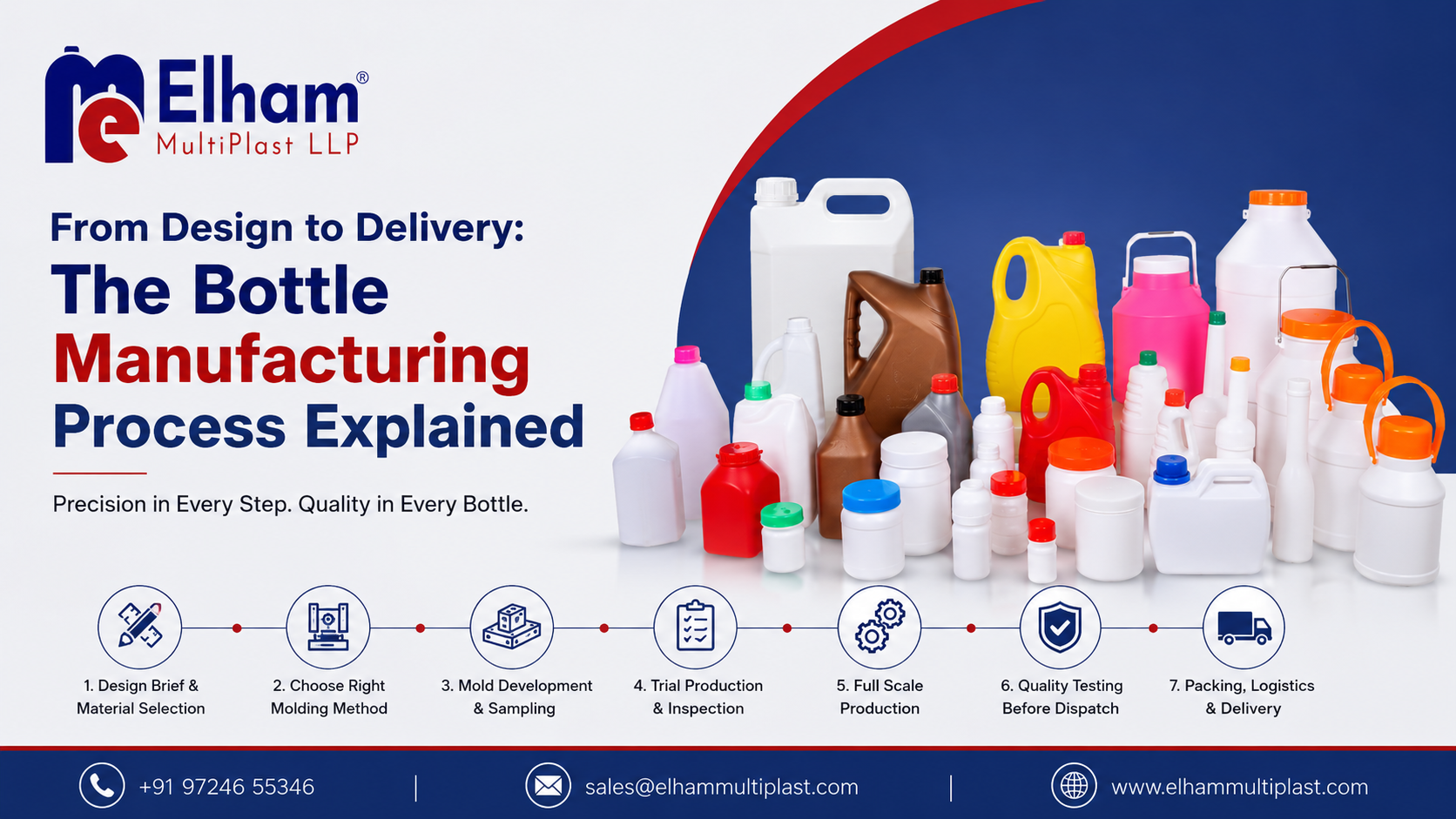
From Design to Delivery: The Bottle Manufacturing Process Explained
September 30, 2026
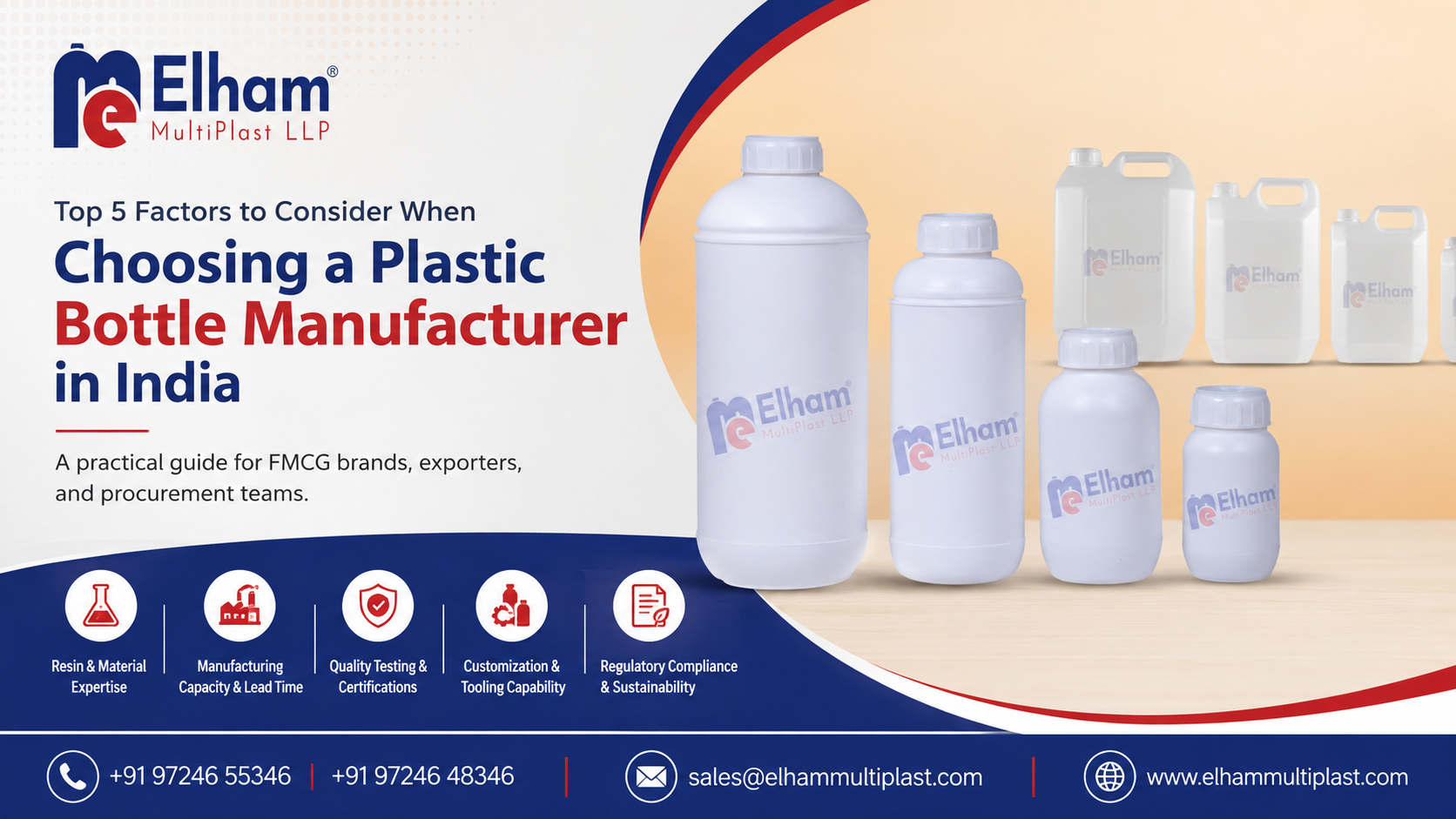
Top 5 Factors to Consider When Choosing a Plastic Bottle Manufacturer in India
September 30, 2026
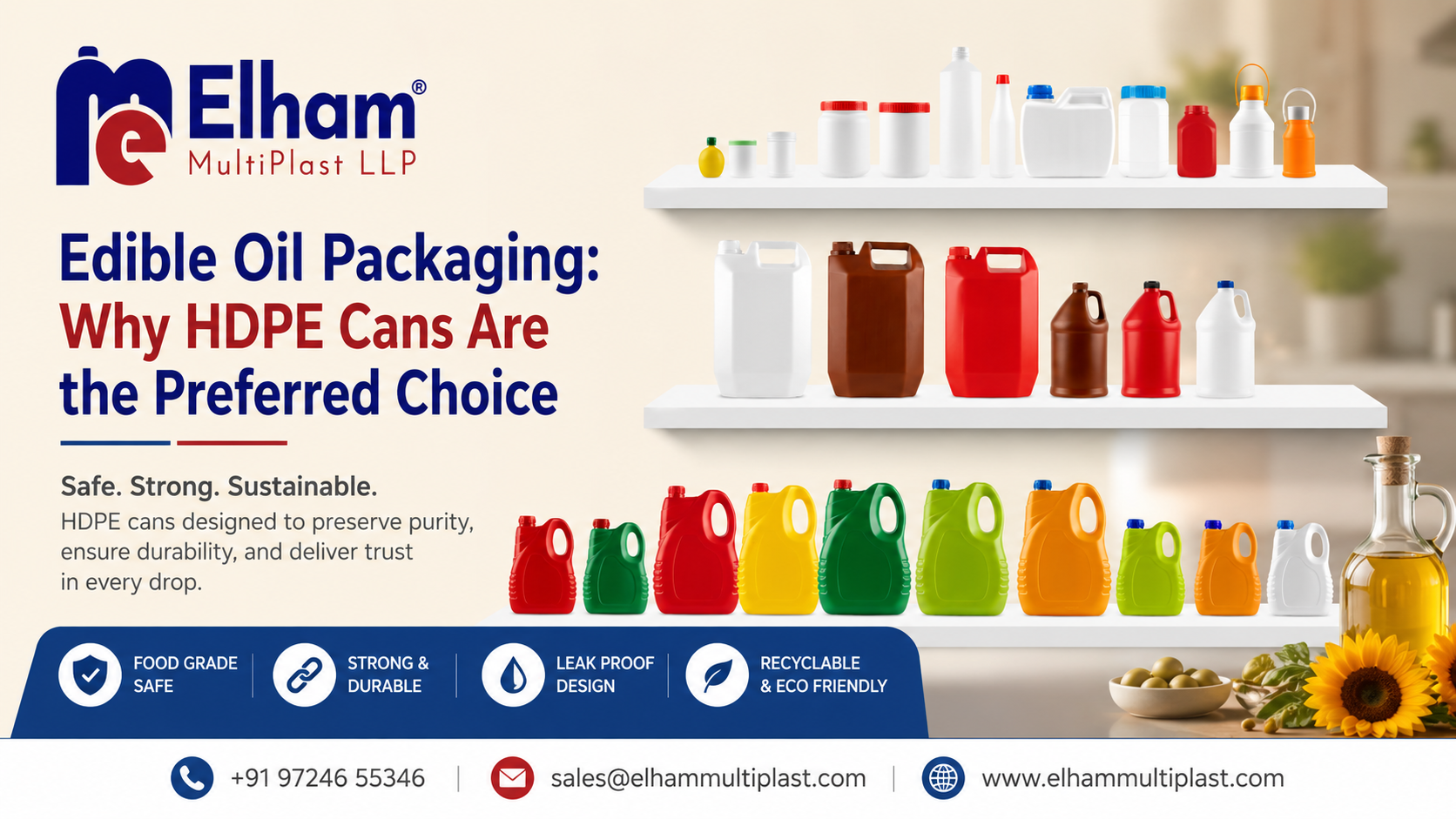
Edible Oil Packaging: Why HDPE Cans Are the Preferred Choice
September 28, 2026