HDPE Bottle Packaging for Chemicals: Key Benefits and Safety Considerations
October 22, 2026
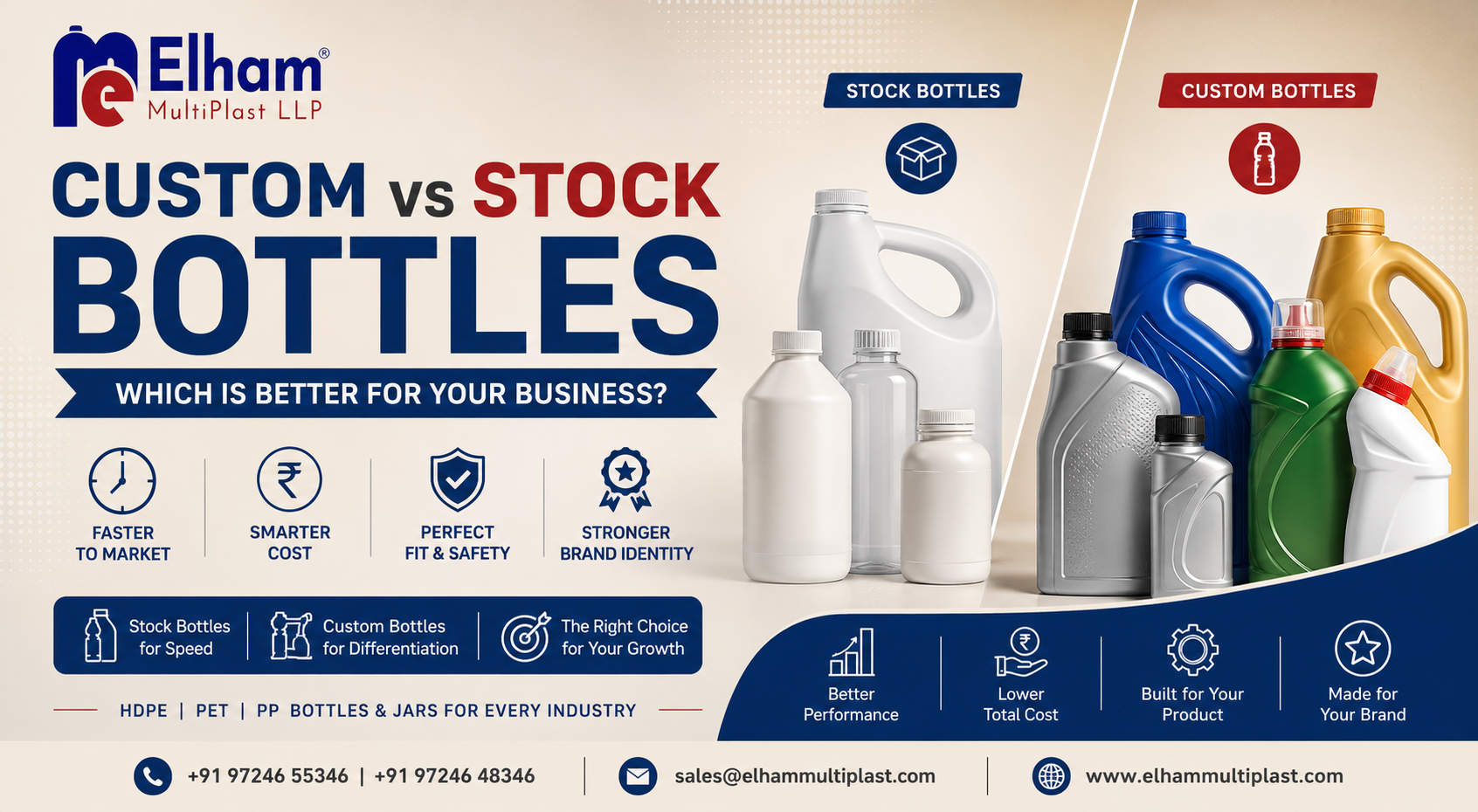
Picking between custom and stock packaging looks like a pricing question. It is really a question about risk, timing and what your product needs to do. A stock bottle gets you to market in weeks. A custom bottle can take months, but it can fit your formulation, your filling line and your brand in ways a catalogue bottle never will.
This guide is written for FMCG brands, pharma and chemical manufacturers, exporters and startups who are sourcing custom plastic bottles and need a working framework, not a sales pitch.
Custom or Stock?
Stock bottles are ready made designs produced from existing moulds. They suit new launches, small and medium runs, and products with simple packaging needs. Custom bottles are made from a mould built for your design. They suit high volume products that need a distinctive shape, exact capacity, special neck finish or protection against copying. Many brands do best with a middle path: a stock mould with custom colour, closure and labelling.
What Is a Stock Bottle?
A stock bottle is a standard design a manufacturer already produces. Capacities, shapes and neck finishes are fixed, and you choose from what exists. Typical examples include 200 ml fabric conditioner bottles, 1 litre lubricant bottles and 5 litre cans, in resins like HDPE, PET and PP.
Because the mould already exists, there is no tooling cost to you, and samples and first orders can move quickly.
What Is a Custom Bottle?
A custom bottle is built to your specification through a dedicated mould. Shape, capacity, wall thickness, neck, handle, embossing and colour are all decided by you and engineered by the manufacturer. This is what an OEM bottle manufacturer does: makes packaging to your design and brand, rather than selling its own catalogue.
The upside is fit and differentiation. The cost is tooling, validation time and a higher volume commitment.
Custom vs Stock Bottles at a Glance
| Factor | Stock bottles | Custom bottles |
| Upfront cost | Low to none | Tooling cost for the mould |
| Order quantity | Generally lower | Generally higher, to justify tooling |
| Lead time | Short | Longer: design, mould, sampling, approval |
| Design freedom | Limited to the catalogue | Full control of shape, size, neck, features |
| Brand identity | Differentiated mostly by label | Shape itself becomes part of the brand |
| Copy risk | Competitors can buy the same bottle | A private mould is hard to replicate |
| Fit with your formulation | May require compromise | Engineered for your product |
| Best for | Launches, pilots, tight timelines | Scaled brands, premium and regulated products |
Stock wins on the first invoice. Custom can win over the life of a product, but only at the right volume.
A custom mould is a fixed cost. Once paid for, your per unit price is driven by resin weight, cycle time and scrap rather than tooling recovery. Savings often come from:
Weight optimisation: Taking a few grams out of every bottle adds up fast at scale and reduces resin spend.
Right sizing: A bottle that holds exactly your fill volume avoids overpacking.
Fewer rejects: A bottle designed for your closure and filling line causes fewer leaks and line stoppages.
Shipping efficiency: Shapes that stack and pack well cut freight cost per unit.
A simple break-even method
Break even volume = tooling cost ÷ (stock bottle total cost per unit − custom bottle total cost per unit)
Here is an illustration with made up numbers, to show the logic only. Say a mould costs ₹4,00,000 and a custom bottle saves ₹1.50 per unit through lighter weight and fewer rejects compared with the stock option. Breakeven is about 2,66,000 bottles. If you expect to use that volume within a year or two, custom starts making financial sense. If you will never reach it, stock is the smarter route. Ask your supplier for a real tooling quote and plug your own numbers in.
MOQ changes depending on what you are changing. It is usually lowest for a plain stock bottle, higher once you add custom colour, printing or decoration, and highest for a new mould. When a supplier quotes a single MOQ for everything, ask them to break it into separate scenarios.
A fair question for any supplier: “What is your MOQ for (a) a stock bottle as it is, (b) a stock bottle in my colour with my closure, and (c) a new custom mould?”
Stock bottles can often ship quickly, depending on availability. Custom bottles have more stages: design finalisation, mould making, sample approval, pilot batch, then production. Each approval you delay moves your launch date.
Practical tip: start custom projects well before you need volume, and keep a stock bottle as a bridge for early sales if you can.
On a crowded shelf, label design carries a lot of weight, but shape does a lot of silent work too. A distinctive bottle is recognisable from across a room, and a private mould is harder for rivals to imitate than a catalogue design that anyone can order.
If your product is premium, or you operate in a category with lookalikes, a unique bottle is a long-term asset. If you are testing demand, a strong label on a stock bottle is usually enough.
This is the part many comparison guides skip, and it matters most for chemicals and regulated products.
Resin compatibility: HDPE resists many solvents and detergents, but some formulations can cause stress cracking in the wrong grade. PET gives clarity but suits a different set of products. Resin choice should follow your formulation.
Neck finish and closure: The neck and cap must match your filling line and sealing method, whether induction seal, tamper evident or child resistant.
Wall thickness and strength: Heavier products need adequate top load and drop performance.
Barrier needs: Some products need protection from oxygen, light or moisture.
Handling features: Handles, grip areas, pour spouts and measuring caps can improve usability.
If a stock bottle meets all of these, use it. If you are compromising on any of them, that is a sign custom is worth exploring.
Stock does not mean unlimited stock. When the same design is sold to many customers, availability can tighten at peak times, and specifications can drift between batches if production is shared. With a private mould, the capacity is yours and the specification is locked.
Whichever route you choose, ask about batch consistency, and request test records. At Elham, torque, leakage, drop and burst checks are part of our quality assurance process.
Regulation can push you toward one option or the other:
Pharma and veterinary packaging often need material grade documentation and tighter control over closures. See our veterinary bottles.
Agrochemical and chemical products may be classified as dangerous goods for transport, in which case packaging may need to meet UN rated requirements. Confirm this with your supplier and your logistics partner before locking a design. See our agro chemical and pesticide bottles.
Sustainability rules: India’s EPR framework affects brands, so ask about recyclability and recycled content options.
Exports: If you plan to ship overseas, ask about pack out standards and container loading from the beginning. Export quality plastic bottles need consistency from the first pallet to the last.
The Middle Path: Semi Custom Bottles
You do not have to choose between catalogue and clean sheet. Many brands start here:
| Level | What changes | Best for |
| Stock bottle + label | Branding on the label only | Launch, testing |
| Stock mould + custom colour | Colour matched to your brand | Early growth |
| Stock mould + custom closure or finish | Better fit or function | Products with specific filling or safety needs |
| Stock mould + embossing or an inserted logo | Subtle ownership of the shape | Brands that want a distinct look without full tooling |
| New custom mould | Full control | Scaled, differentiated or regulated products |
Ask your supplier which of these they can support. Moving up one level at a time lets you grow your packaging along with your sales.
Which One Fits Your Business?
Startups and new launches: Begin with stock. Keep cash free and learn what customers want. Upgrade later.
FMCG brands scaling up: Look at a semi-custom or custom bottle once volumes are predictable. The savings and brand value start to compound.
Pharma and veterinary companies: Prioritise compliance and closure performance. Custom is often worth it for tamper evidence and dosing features.
Chemical, lubricant and agro manufacturers: Resin compatibility and transport rules lead the decision. See our lubricant bottles and liquid detergent bottles.
Exporters: Choose whichever gives consistent specification and reliable dispatch, and plan lead times with shipping in mind.
A Practical Checklist Before You Decide
Estimate your annual volume honestly, and your volume in year two.
Confirm your filling line’s neck and closure requirements.
Check resin compatibility with your formulation.
Ask for separate MOQs for stock, semi-custom and new mould.
Request a tooling quote and run the breakeven calculation.
Get written lead times for sampling and production.
Test samples with your product, including transport and shelf-life checks.
Run a pilot batch before full production.
For the broader supplier evaluation, read our guide to choosing a plastic bottle manufacturer in India, and to see how a mould becomes a bottle, see the bottle manufacturing process explained.
Frequently Asked Questions
What is the difference between custom and stock bottles?
Stock bottles are standard designs made from existing moulds. Custom bottles are made from a mould built to your specification, giving you control over shape, size, neck and features.
Are custom plastic bottles more expensive?
They carry an upfront tooling cost and usually a higher MOQ. At sufficient volume, savings from weight, fit and fewer rejects can offset that cost, so total cost matters more than unit price.
What is the MOQ for custom plastic bottles?
It depends on whether you are changing colour, closure or decoration on a stock mould, or building a new mould. Ask for each scenario separately.
Can I brand a stock bottle?
Yes. Labels, printing, custom colours and closures are common ways to make a stock bottle feel like your own.
Which is better for a startup?
Usually stock, because it keeps cash free and lead times short. Move to semi custom or custom once demand is proven.
HDPE or PET for chemical products?
HDPE is generally preferred for detergents, lubricants and agrochemicals due to chemical resistance and opacity, while PET suits products that benefit from clarity. Always test against your actual formulation.
What does an OEM bottle manufacturer do?
It manufactures bottles to your design and specification under your brand, instead of selling only its own catalogue products.
Final Thoughts
Neither option is better in every case. Stock bottles reward speed and flexibility, custom bottles reward fit, brand value and scale, and the semi-custom path lets you step between them. The right choice comes down to your volume, your product’s technical needs and your timeline.
Elham MultiPlast LLP manufactures HDPE, PET and PP bottles and jars from two units in Himmat Nagar and Surat, Gujarat, supplying clients across industries and countries. If you are weighing your options, request a quotation for custom and stock bottles and we will help you compare both routes with real numbers.
HDPE Bottle Packaging for Chemicals: Key Benefits and Safety Considerations
October 22, 2026
Custom vs Stock Bottles: Which Is Better for Your Business?
October 22, 2026
Plastic Jars for Every Industry: Uses, Sizes and Benefits
October 5, 2026
Lubricant and Coolant Bottle Packaging: What Manufacturers Need to Know
October 5, 2026
Sustainability in Plastic Packaging: How Elham MultiPlast Is Adapting
September 30, 2026
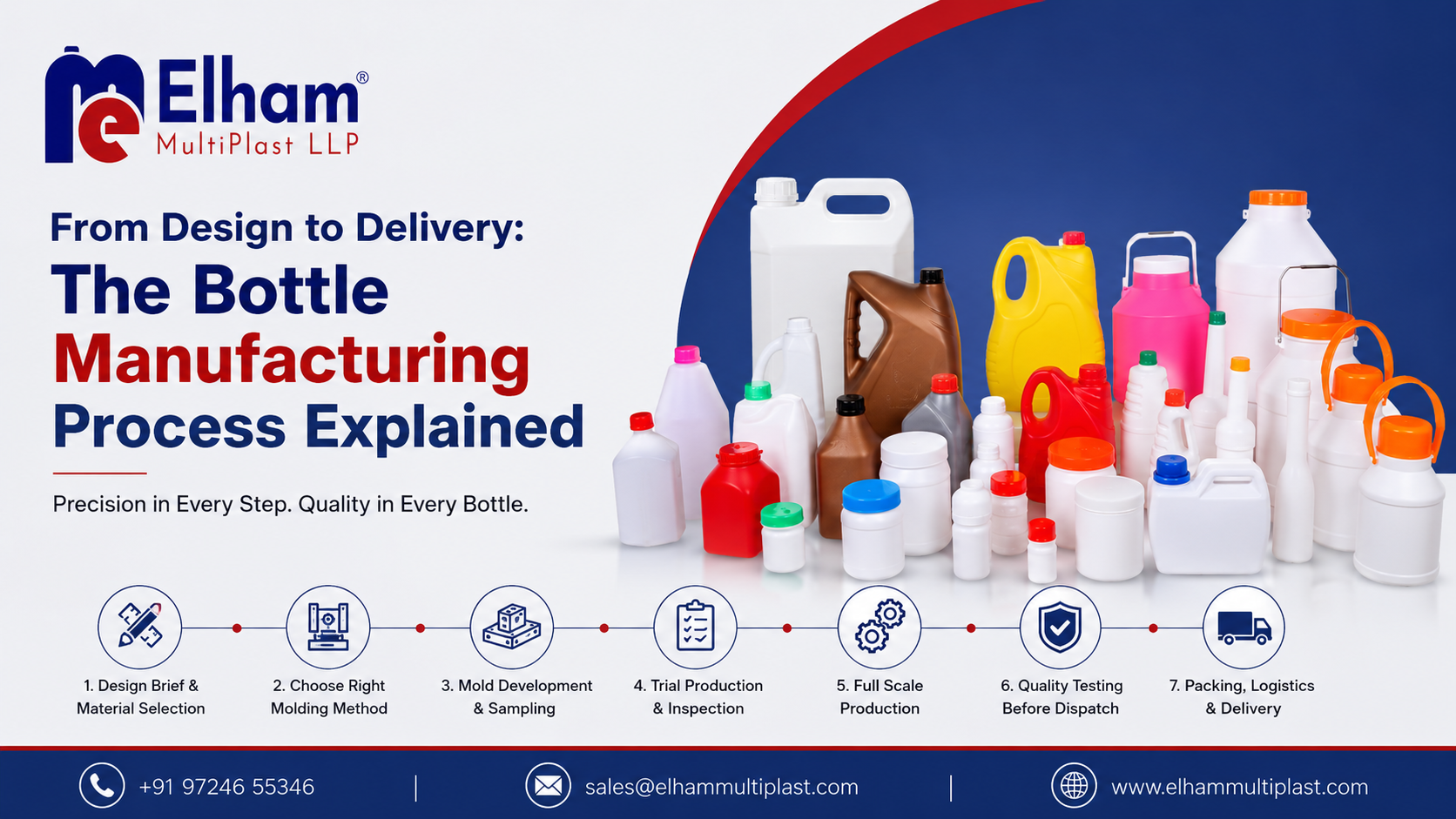
From Design to Delivery: The Bottle Manufacturing Process Explained
September 30, 2026