500ml to 5L Liquid Detergent Bottles: Choosing the Right Packaging Size for Your Business
November 24, 2026
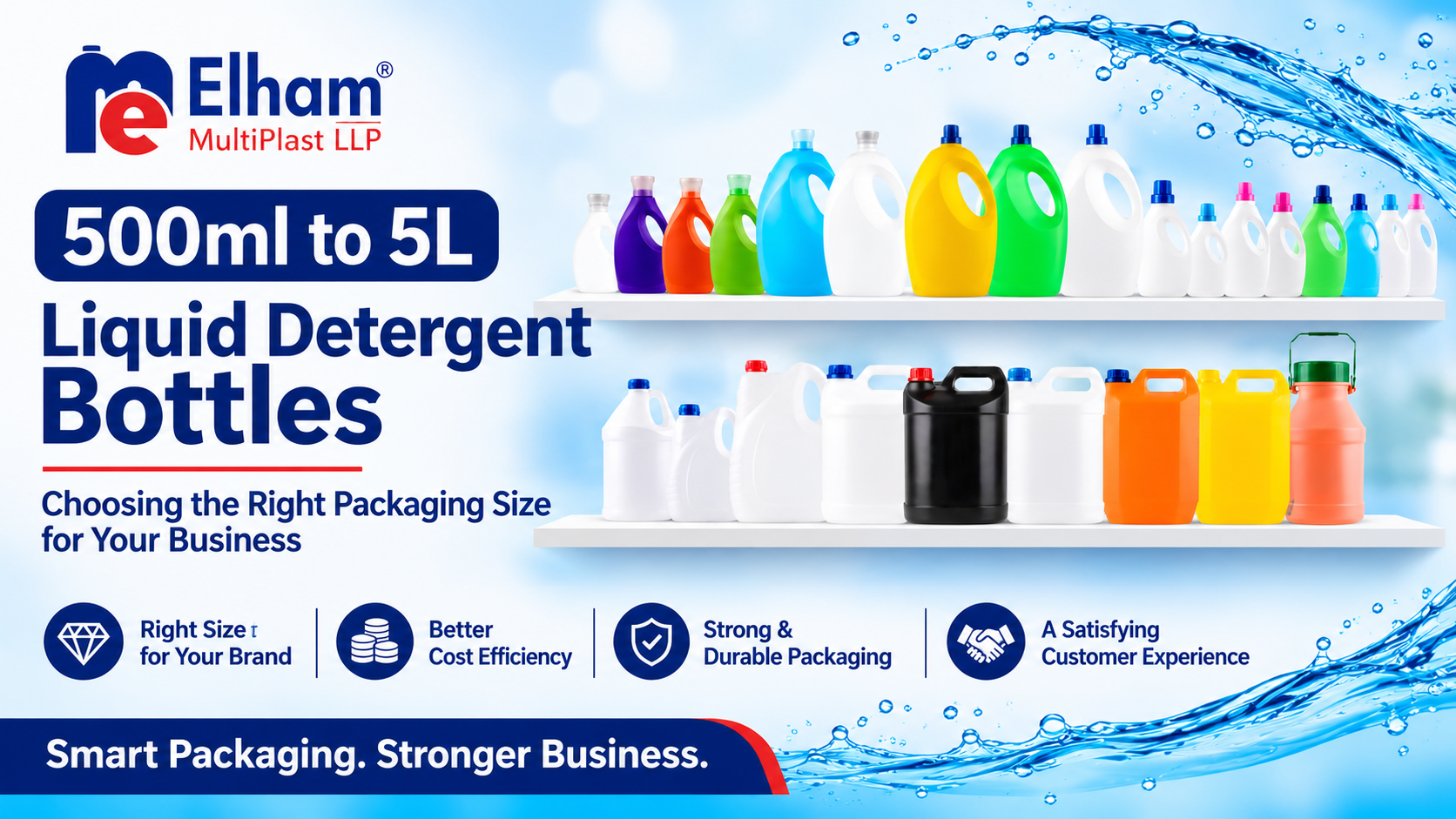
Most detergent brands choose a bottle size the way they choose a price point: by looking at whoever sits next to them on the shelf. That works until the first reorder, when the 500 ml pack leaves a thin margin, the 2 L pack is hard to pour with wet hands, or the 5 L pack cracks at the base on a summer truck. Liquid detergent bottles look like simple containers, but the size you pick decides your cost per litre, your shelf position, your freight and how a customer feels while using the product.
This guide walks through the five sizes most detergent and cleaning brands actually order, which are 500 ml, 1 L, 2 L, 3 L and 5 L. It explains who each size suits, what changes in the bottle as the volume grows, and how to test a pack before you commit to a full run. If you are a detergent manufacturer, an FMCG team, a cleaning product company or a wholesale buyer, treat it as a working checklist.
Quick answer: which liquid detergent bottle size should you choose?
Choose by buyer and channel, not by habit. A 500 ml bottle suits trial packs and general trade, 1 L is the everyday retail pack, 2 L and 3 L suit family packs for modern trade and online sales, and 5 L suits bulk, institutional and refill use. Once the size is set, confirm the cap, neck, wall weight and your filling line speed before you place the order.
The five sizes at a glance
| Size | Typical buyer | Common channel | Main strength | Main watch out |
| 500 ml | First time buyers, small households, travellers | Kirana shops, general trade, sampling | Low price at the shelf, quick trial | Cap and label take a larger share of pack cost |
| 1 L | Everyday household | Kirana, supermarkets, ecommerce | Balanced price, easy to carry | Most crowded shelf, easy price comparison |
| 2 L | Families that wash often | Modern trade, ecommerce | Better value per wash | Needs a proper handle and grip |
| 3 L | Large families, small businesses | Modern trade, ecommerce, small institutions | Fewer reorders for the buyer | Heavy to pour, fewer shelf slots |
| 5 L | Hotels, laundries, hostels, distributors, refill users | Wholesale, institutional supply | Lowest packaging cost per litre | Stack strength, drop performance, decanting |
Why bottle size is a business decision, not only a packaging one
A bottle size touches almost every part of your operation. Before you compare moulds or caps, answer four questions honestly.
Who is buying? A student sharing a flat, a family of five and a hotel housekeeping head all use the same liquid in very different quantities.
Where is it sold? A kirana shop prefers a pack that moves fast at a price customers can pay without thinking. A supermarket wants a pack that looks right in a row of competitors. An online buyer needs a pack that survives a courier.
How is it stored and carried? Liquid detergent weighs slightly more than water, so a 5 L pack is a little over 5 kg before you add the bottle and carton. If the pack is awkward to lift, customers notice before they notice your fragrance.
How will you fill it? Every size change line speed, capping torque, carton count and pallet pattern. A size that looks cheap on paper can slow a line that is already running at capacity.
India’s liquid detergent category is still growing. IMARC Group estimates the market at about USD 1.2 billion in 2025; with growth of roughly 5 percent a year projected to 2034. In a category that is expanding but crowded, a well-chosen size ladder lets a brand enter at a low price and move customers up to larger packs over time.
500 ml: the trial pack and the entry price
The 500 ml bottle is where many customers first meet a brand. It sits comfortably between a sachet and a litre pack, which makes it a natural upgrade for shoppers who are moving away from powder or pouches and want to try a liquid.
Where it works best
Trial and sampling campaigns
Kirana and general trade with fast stock rotation
Travel, hostel and guest room use
Dish wash, floor cleaner and hand wash variants where 500 ml is already the habit
What to check
At this size the closure matters more than people expect, because the cap and label together can represent a large part of the pack cost. Weight is the other lever. A bottle that is too light may look economical but can buckle when stacked in a carton or squeezed during transport.
500ml liquid detergent bottle with knurling cap: what the cap adds
A knurling cap has fine ridges around its outer edge. The ridges give fingers a firmer hold, which matters when hands are wet or soapy, and they help a user turn the cap with controlled pressure instead of slipping. They also support a tidier pour, because a steady grip leads to a steadier tilt.
Elham MultiPlast’s Elham Shape bottle with knurling cap is offered in 500 ml, 1 L, 2 L, 3 L and 5 L, which means a brand can keep one bottle language across its whole size ladder. That consistency helps shoppers recognise your range at a glance, and it simplifies label design because the proportions stay familiar.
1 L: the everyday workhorse
If a brand could only sell one size, it would most likely be 1 L. It carries enough product for several weeks in a small household, fits a standard shelf, and sits at a price that most shoppers will pay without long thought.
The challenge is competition. Because 1 L is the reference size, shoppers compare it directly with other brands, often by price per litre. A distinctive shape, a clear label panel and a cap that feels good in the hand are the quiet advantages here. A 1 L bottle should also have a drip free pour, since customers use it daily and a sticky bottle neck is the first thing they complain about.
Trade portal listings in India show plain HDPE bottles in 500 ml and 1 L at very small per piece prices, which tells you how price sensitive this segment is. Treat any listing as a rough signal rather than a quote, because weight, cap, colour and order size change the figure.
2 L and 3 L: the family pack
Once a household trusts your detergent, a bigger pack saves them money and trips. This is also where design starts to matter more than cost.
A 2 L pack holds roughly 2 kg of liquid and a 3 L pack closer to 3 kg. Pouring that weight from a smooth, handleless bottle is uncomfortable, so these sizes usually need a moulded handle, a firm grip zone and a base wide enough to stay steady on a washing machine or a shelf. A cap that opens cleanly and closes with a positive feel reduces the chance of a leak in the cupboard.
Where it works best
Modern trade and supermarket shelves
Ecommerce, where larger packs reduce the shipping cost per wash
Families, shared flats and small businesses such as salons and tailoring units
What to check
The shoulder and handle area carry stress when the bottle is lifted full. Ask for even wall thickness there, and test filled bottles by lifting them by the handle after ageing, not only on day one.
The jump from 2 L to 3 L is smaller than it looks. If your shelf space or your filling line is limited, many brands choose one of the two as their family size and skip the other.
5 L: bulk, institutional and refill use
A 5 L pack is not a bigger version of a retail bottle. It is a different product with a different buyer. Hotels, hostels, laundries, canteens, distributors and cleaning contractors buy it because it lowers the cost per litre and reduces how often they reorder. Households that like to refill smaller bottles also buy it.
HDPE can or PET jar?
Both exist in this size, and the right choice depends on the liquid and the sales pitch.
An HDPE bottle with a handle is the traditional choice for detergent and heavy-duty cleaners. It resists impact and many surfactant-based liquids.
A PET jar is clear, which lets the customer see the colour of dish wash or floor cleaner and judge how much is left. Elham MultiPlast’s 5 litre cut size dish wash bottle is a PET jar offered in 4.5 litre and 5 litre cut sizes, so confirm the brimful capacity against the fill volume you plan to print on the label.
What to check
A full 5 L pack stores a lot of energy. Check stack strength in the carton, performance when dropped from pallet height, and how well the handle bears the load after weeks of storage. Ask also how easily the customer can pour or decant, because a bulk buyer who struggles with a heavy pour will switch brands.
Seven specifications that matter at every size
Size gets the attention, but these details decide whether the bottle performs.
| Specification | Why it matters | How it changes with size |
| Material | HDPE is the usual choice for liquid detergent because it is tough and resists most household cleaning formulas | Larger sizes need resin with good stress crack resistance |
| Bottle weight | Drives cost and strength together | Grams per litre usually fall as size rises, but wall thickness at the base and shoulder still needs checking |
| Neck and cap match | A near fit is a common cause of leaks | The cap must suit both the neck drawing and your torque setting |
| Liner or induction seal | Stops weeping during transport | More important for ecommerce and long-distance freight |
| Handle and grip | Controls pouring comfort | Essential from 2 L upward |
| Label panel | Carries regulatory text, claims and barcode | Smaller bottles have less room, so plan the artwork early |
| Colour and finish | Affects shelf appeal and light protection | Custom colours usually come with minimum quantity conditions |
If you want a deeper look at how closures and necks work together, read our guide to leak proof plastic bottles. For a view of how HDPE behaves with different chemistries, see our notes on HDPE bottle packaging for chemicals.
Which size fits which kind of business?
A new brand testing the market. Start with 500 ml and 1 L. They need less stock, give faster feedback on fragrance and price, and let you test two price points without tooling two different bottle families.
A regional brand growing into modern trade. Add 2 L as your value pack. It gives supermarkets a larger shelf item and gives loyal customers a reason to buy more per visit.
A national FMCG team. Run a full ladder from 500 ml to 5 L, keep the bottle design consistent, and use the larger sizes for promotions, bundles and ecommerce.
A cleaning product supplier to hotels and institutions. Focus on 5 L, with a 1 L bottle for sampling. Spend your design effort on handle comfort, stack strength and clear labelling for staff.
A private label manufacturer. Choose sizes that suit the retailer’s shelf plan, and ask your bottle supplier early whether a stock shape can be coloured and labelled to match the client’s brand.
A simple way to compare sizes: cost and washes
Buyers rarely think in bottle capacity. They think in cost per wash. This is an illustration only, not a recommendation for your product. Suppose your formula is dosed at 30 ml per wash. The same dose gives:
| Bottle size | Approximate washes |
| 500 ml | 16 |
| 1 L | 33 |
| 2 L | 66 |
| 3 L | 100 |
| 5 L | 166 |
Use your own dose from your lab or label claim. The point is that the larger bottle needs to look like fair value in this math, otherwise a customer who is price aware will keep buying the smaller size and a bulk buyer will keep negotiating.
On the packaging side, expect cost per litre to fall as bottles get larger, because the cap, label and handling steps are spread over more product. What it does not do is fall evenly. The saving between 1 L and 2 L is usually larger than between 3 L and 5 L, so test the quote at each size instead of assuming a straight line.
Check your filling line and supply chain before you decide
A bottle can be right for the market and wrong for the factory. Confirm these points with your plant team.
Brimful versus fill volume. Leave headspace so foam and heat expansion do not push liquid into the cap threads.
Line speed and changeover. Each new size means new guides, new capping heads and often a new carton pattern.
Carton and pallet pattern. A small change in bottle width can change how many cartons fit on a pallet.
Ecommerce handling. Industry commentary has pointed out that many household bottles and closures were never designed for parcel networks, which is why leaks show up when a brand begins selling online. If you plan to sell online, test filled and capped bottles in the final shipper.
Test the filled bottle, not the empty one
An empty sample proves very little. The failures that cost brands money usually appear after the liquid has been inside the bottle for weeks.
Compatibility. Fill the bottle with your actual formula and age it at room temperature and at an elevated temperature. Check for deformation, odour change and discolouration.
Stress cracking. Surfactants and perfumes can speed up environmental stress cracking in polyethylene, especially near the base, shoulder and handle joint. Heat makes it worse.
Leak and torque. Set a validated cap torque, then test leakage with the bottle inverted and under light pressure.
Drop and stack. Drop filled cartons from the heights your distribution actually produces, and load test the bottom layer of a pallet.
Label performance. Check that labels hold when wet, when stored in a damp bathroom and after rubbing with soapy hands.
A supplier who talks about these tests before you ask is usually one that has seen the failures first hand.
Sustainability and compliance, without the buzzwords
A few practical steps matter more than slogans.
Use one polymer family. An HDPE bottle with a polypropylene cap is widely accepted in plastic recycling streams, and keeping the pack simple helps sorting.
Lightweight with evidence. Removing a few grams per bottle can save real money across a year, but only if filled bottle tests still pass.
Treat recycled content as a trial. Recycled resin can change stress crack behaviour and odour, so run controlled trials before you switch fully.
Plan for Extended Producer Responsibility. India’s Plastic Waste Management Rules place obligations on producers, importers and brand owners, so confirm your registration and recycling duties with a compliance advisor.
Plan the label panel. Net quantity, price and other declarations required under the Legal Metrology (Packaged Commodities) Rules need space. Smaller bottles feel this most.
Stock bottle or custom bottle?
A stock bottle uses an existing mould. You choose the size, colour and cap, then add your label and launch sooner. A custom bottle uses a dedicated mould and gives you a shape no one else has, but it carries tooling cost and a longer lead time.
For most brands, the smart path is to start with a stock shape for 500 ml and 1 L, learn what sells, and move to a custom design once volume justifies the tooling. Our article on custom vs stock bottles explains the trade-offs in more detail.
A hypothetical example: the brand that skipped the 3 L
This is an illustration, not a client case. A regional detergent brand sells 500 ml and 1 L bottles and wants a bigger pack for supermarkets. The team debates 2 L, 3 L and 5 L.
They notice that their customers rarely buy more than one 1 L bottle at a time, that their filling line is already near capacity, and that a 5 L pack would need a new handle design and a new carton. They choose a 2 L bottle with a handle and a knurling cap as the family pack, test it filled and aged, and keep 5 L for a later institutional launch.
Nothing about this is dramatic. It is a calm decision made from buyer, channel and line capacity, which is exactly how a size ladder should grow.
How to choose the right liquid detergent bottle size in six steps
Define your buyer. Household, small business or institution.
Map your channels. Kirana, modern trade, ecommerce or wholesale.
Set your price ladder. Decide the entry price, the everyday price and the value price.
Check your line. Confirm capping, filling and carton changes for each size.
Shortlist the bottle and cap. Ask for drawings, weights and samples.
Test filled, aged and shipped packs. Approve only when the tests pass.
How to choose a manufacturer for liquid detergent bottles
Look at the range. A supplier that already makes detergent, dish wash and softener bottles understands foam, fragrance and surfactants.
Ask about testing. Torque, leakage, drop and burst checks should be routine, and a good supplier will share what they measure. You can read how we approach this on our quality assurance page.
Request samples. Fill them with your product, cap them on your line and age them.
Check capacity and location. Two production units lower the risk of delay. Gujarat has become a strong base for plastic packaging, and we explain why in our article on Gujarat as a hub for plastic packaging.
Read the wider checklist. Our guide to choosing a plastic bottle manufacturer in India covers questions buyers often forget.
How Elham MultiPlast supports detergent and cleaning brands
Elham MultiPlast LLP manufactures HDPE, PET and PP bottles and jars from two units in Himatnagar and Surat, Gujarat. Our range of liquid detergent bottles covers laundry detergent, dish wash, surface cleaners and fabric care. The Elham Shape bottle with knurling cap is available from 500 ml to 5 L, and our PET jar range covers dish wash and similar liquids in bulk sizes. Brands that also sell fabric care can pair these with our 200 ml fabric softener bottle and keep their detergent and softener packs with one supplier.
We work with both stock and custom bottles, and our company profile lists customers across more than 27 countries. Tell us your product type, fill volume, closure preference and target colour, and we will help you shortlist a bottle worth testing. You can request a quotation and samples, download the catalogue, or browse the full product range.
Frequently asked questions
What size bottle is best for liquid detergent? There is no single best size. Use 500 ml for trial and general trade, 1 L for everyday retail, 2 L or 3 L for family packs, and 5 L for bulk and institutional use. The right choice depends on your buyer, channel and filling line.
What is the most common liquid detergent bottle size? 1 L is the most widely sold retail size because it balances price, shelf space and carrying weight. Many brands then add 500 ml below it and 2 L or more above it.
What material are liquid detergent bottles made of? Most are made of high-density polyethylene (HDPE), usually with a polypropylene cap. HDPE is tough, resists most household cleaning formulas and is widely accepted in recycling streams. Some dish wash and floor cleaner packs use PET when a clear look is wanted.
Why do detergent bottles have handles? A full 2 L, 3 L or 5 L bottle is heavy, and a handle makes lifting and pouring safer and more controlled. It also helps with carrying from store to home.
What is a knurling cap on a detergent bottle? It is a cap with fine ridges around its edge. The ridges improve grip when hands are wet or soapy and help users open, close and pour with more control.
How many washes will a 1 L detergent bottle give? That depends on your dose. At 30 ml per wash, it gives about 33 washes, but your own label dose decides the real figure.
Can I choose a custom colour or shape for my detergent bottle? Yes. Custom colours are possible, usually with minimum quantity conditions, and a new shape needs a dedicated mould. Discuss volume early so your supplier can recommend stock or custom.
Are liquid detergent bottles recyclable? HDPE bottles with polypropylene caps are generally accepted in plastic recycling streams, though local collection varies. Using one polymer family and limiting extra labels helps.
Can a bottle leak even if the cap looks tight? Yes. Leaks usually come from a mismatch between neck finish and cap, a missing liner, or untested torque. Check the drawings together and test filled bottles.
What should I ask a liquid detergent bottle manufacturer before ordering? Ask for bottle and cap weight, neck and cap drawings, resin type, colour options, test methods, minimum order quantity and lead time. Then order samples and test them with your own product.
Final thoughts
The best liquid detergent bottle size is the one that matches your customer, your channel and your factory at the same time. Start with the buyer, build a size ladder that makes sense in cost per wash, and let the bottle details follow: handle, cap, wall weight and neck. Then test filled, aged and shipped packs before you scale. That is how a bottle stops being a cost line and starts helping you sell.
500ml to 5L Liquid Detergent Bottles: Choosing the Right Packaging Size for Your Business
November 24, 2026
200 ml Fabric Softener Bottles: The Ideal Packaging Solution for Fabric Care Brands
November 17, 2026
Leak Proof Plastic Bottles: Features That Prevent Packaging Failures
November 13, 2026
What Makes a Good Pesticide Bottle? Key Packaging Features to Consider
November 10, 2026
Why Gujarat Is Becoming a Hub for Plastic Packaging Manufacturing
October 24, 2026
HDPE Bottle Packaging for Chemicals: Key Benefits and Safety Considerations
October 22, 2026